Author: dhammerslag

  • The Fog 3: Fire-Builder

    The Fog 3: Fire-Builder

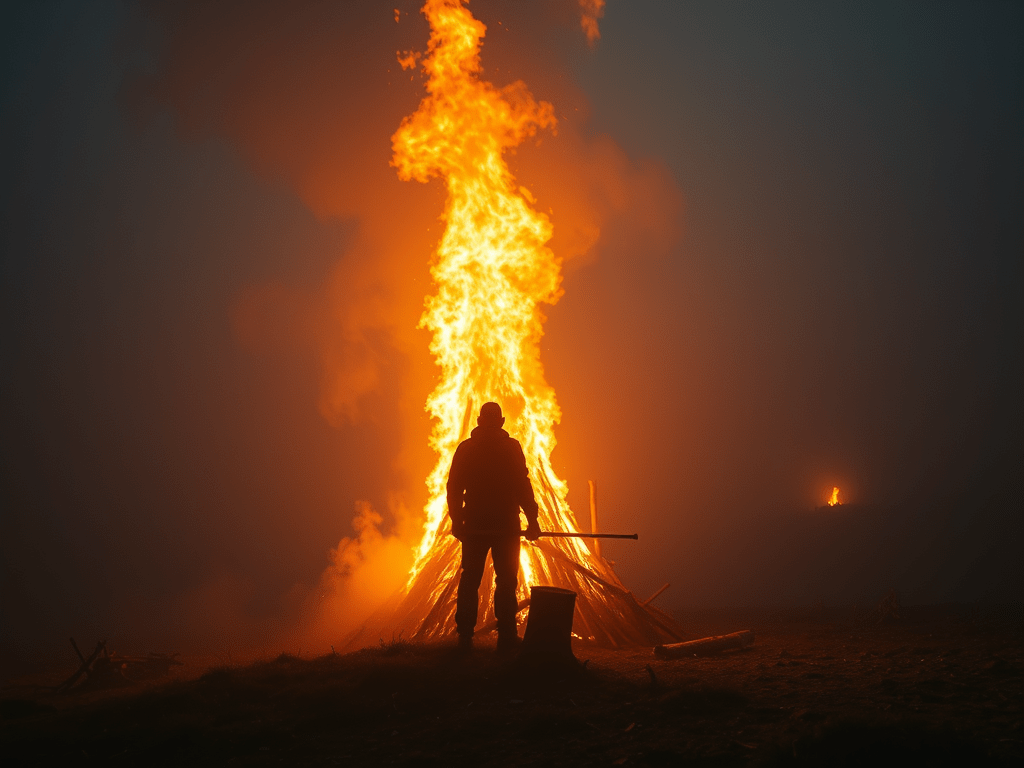
    Soon, with the fire-master at my side in the Valley of Fire, I was building my first real fires. As I look back now, they were not very great fires, nothing like what I would build later, but the fire-master was always extolling the virtues of my creations. “It is so very bright!  See how it drives back the Fog! And the warmth it gives! The chill dampness is all but gone!” Standing by my fires, listening to the mesmerizing voice of the fire-master, I could even forget that I remained in the Fog. I began to feel like the master of my own destiny; I could, by my own cunning and effort, defeat the Fog.

    Reality soon inserted itself into my reverie. The comfort and security of the fire, although more concrete than anything I had gotten from the now dimly remembered Light, was ultimately transient. As my first fires consumed all their fuel and there was no more to add, they grew dim, flickered, smoked, and went out. Each time a fire died, the Fog crept back in. Eventually, the fire was gone, leaving nothing but the stench of damp ashes; the oppressive weight of the Fog seemed even heavier than before the fire was kindled. Despair crept over me; all my work was for naught.

    In those moments, too, the fire-master was at my side. He would reassure me that the temporary nature of my fires could be overcome. If I worked harder and listened to him, I could have a fire that would truly last and truly satisfy. When my fire did not last until dawn (as was often the case), he would point out the importance of being a fire-builder. “See how the Fog closes in, as if to consume you? There is no telling what dangers are out there in the Fog. The bigger and brighter your fire is, the more it will dispel the Fog and the safer you will be.”

    Danger in the Fog?  I have always loathed the Fog, and I longed to be free of it, but I had never thought that the Fog concealed danger. But as soon as the fire-master mentioned it, it made perfect sense. Surely all manner of danger lay hidden in the Fog. It was easy to believe that the Fog itself was a malevolent force intent on cloaking danger in its cold mist.

    As time passed, the fire-master encouraged me to build my fires ever higher and higher.  When I was wandering alone, I built small fires, just big enough to cheer myself and give myself a bit of warmth against the cold dampness of the Fog. Now I was building massive bonfires. They burned so bright and hot that they scared me a little; it was hard to get close enough to tend them.  Yet they could not go untended.  They always needed my attention; to let a fire diminish soon became unthinkable. My fires became the only thing that really mattered. I would forego rest and food in order to make my fires bigger and better. But bigger and better fires meant I needed more and more wood.

    Finding wood was always a challenge. As I lingered in the Valley of Fire, I saw that the valley was a sea of stumps; most of the trees had already been cut down. I had to spend most of my day venturing out looking for wood, ever fearful that I wouldn’t find my way back in the Fog.  But the fire-master knew where to find the best wood and always seemed to know the way back to where I had built a rude shelter in the valley.

    On one of my forays in search of wood, I climbed up, partway out of the Valley of Fire. I was surprised to see that the Fog was heavier in the valley than it was up on the ridge. Curious, I continued my climb. As I sat on a large stump, looking out over the Valley of Fire, where the Fog was joined by the smoke of countless fires still burning or smoldering from the night before, I suddenly noticed the Light! I had nearly forgotten that it existed. When in the valley, it was nearly impossible to see the Light. And in my pursuit of ever bigger fires, I had no time to think of things like the faraway, dimly seen Light. Why had I ever been seeking it? Was the fire-master right? Was I a fool for ever having chased after the Light? Was I a fool to have ever sought it? Surely my fires would keep the Fog at bay; what could the Light give me that I could not get for myself from my Fires?  They were much brighter and warmer than the Light, and even though they eventually died out, they were real.  Could I say the same thing about the dimly glimpsed and distant Light?  My fires gave me comfort and security, something the Light seemed to promise, but the promise was never realized. With my fires, I controlled my fate.  I drove the Fog back. I kept myself safe from any dangers lurking in the Fog. What was it about the Light that had once filled me with hope? What had caused me to begin my quest for the Light in the first place? As I wondered, I felt something start to stir within me. It was an ill-defined yearning for something that the Light seemed to offer.

    I had only a moment to wonder about these feelings before the fire-master suddenly appeared at my side. “My friend, I was looking for you and saw you climbing up here. What are you doing so high up out of the valley?” he asked solicitously. “There is not much wood here, and even if you did find some, how would you get it back down your fire? This is no place for you. Come with me back to your fire, and I will show you how to get plenty of wood!” He clutched my arm rather more forcefully than I liked and led me steadily back down into the Valley of Fire. My ineffable yearning and half-remembered desire to get to the Light vanished altogether as the fire-master began telling me of new ways to have the biggest, brightest, and hottest fire.

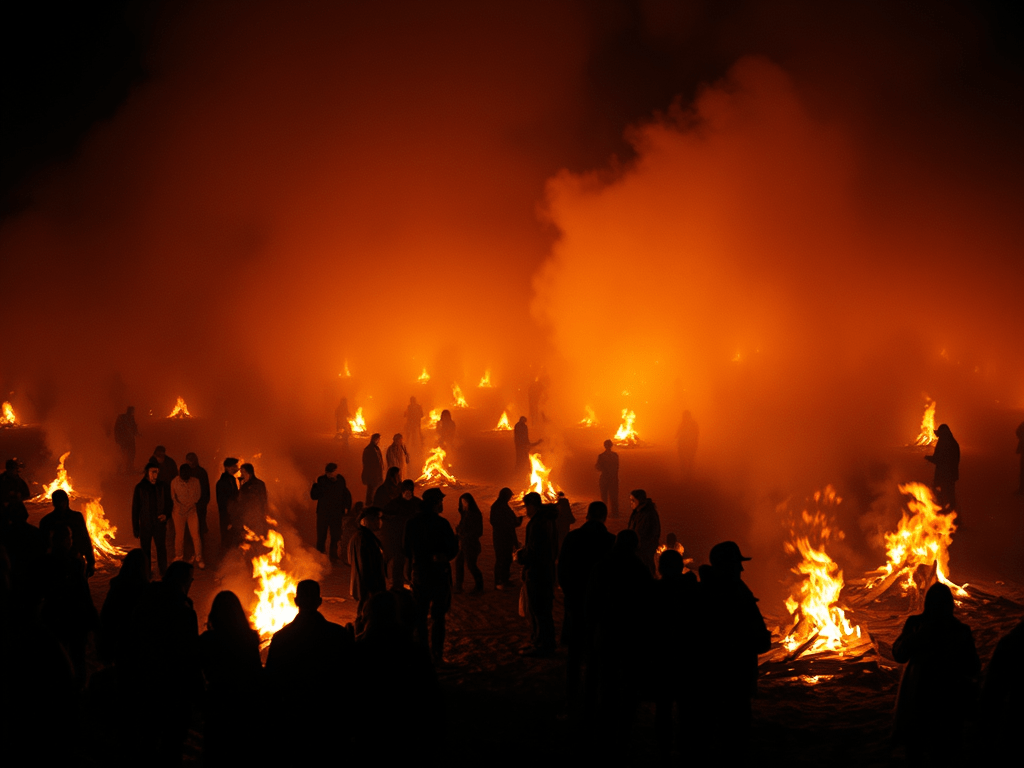
    As we made our way back down the now-barren hillside into the Valley of Fire, I could see the landscape dotted with fires piercing the gray of the Fog. They seemed to extend to the horizon. Some were small, like my first fires, and others were epic bonfires whose size was nearly unbelievable; they looked more like wildfires than bonfires. The fire-master would direct my attention to these other fires, especially the most spectacular ones.  As he praised those fires, a new feeling began to grow inside me. I felt anger and a sense of injustice when I thought that other fires might be considered better than mine. My fire must be bigger, brighter, and better than any others.

    As if he were aware of my thoughts, the fire-master encouraged them, “It isn’t really fair that these others have fires better than yours, is it? Surely you deserve to have the finest, the best, the biggest fire of anyone. You work so hard at it! Why should your neighbor have a better fire than you?”

    Why indeed!

  • The Fog 2: The Valley of Fire

    The Fog 2: The Valley of Fire

    One night, when I had stopped to rest, I saw a most curious sight in a valley below me. Just as darkness fell, lights began to spring up in the valley that lay below me. As I watched, more and more lights sprang to life. Soon they stretched out ahead of me in the direction of my travel. I could not tell how many there were; they extended as far as I could see, eventually being swallowed up by the Fog. I was puzzled. The lights looked like fires, but they seemed to be much too large. I was used to seeing small campfires here and there, but if these were fires, they were much larger than any used for cooking or a bit of nighttime warmth. I was curious, but resolved to let the matter go; I slept.

    The next day, as I expected, the Fog prevented me from seeing down into the valley. I decided I was not going to let some vision of fires deter me from my quest for the Light and resumed my trek. But that night, my resolve faltered. As the day faded away, the lights once again appeared below me. This time, they were behind me as well as in front of me. My day’s journey had not brought me to the end of what must be a quite long valley.  I could not guess just how long the valley was; now the shimmering lights of the fires extended as far as I could see both behind and ahead of me. They were now closer, too. Either my day’s walking had brought me lower, or the floor of the valley was rising. What was the meaning of these fires? My resolve to continue toward the Light crumbled under my curiosity.

    The fires were close enough to me that I dared to clamber down to them. They cast eerily dancing shadows, and I slipped and slid more than once, tripping over an abundance of tree stumps, but overall, the slope down into what I had come to think of as the Valley of Fire was manageable. As I neared the first fire or two, I could see that my suppositions were correct. Here were huge bonfires – much larger than needed for cooking or a bit of warmth on a cold night. These people here seemed to have ceased wandering and settled down in one spot, where they built fires, creating their own light. Had they seen and abandoned the Light that was drawing me? Had they never seen it? Their massive fires certainly seemed to supplant the Light.

    Initially, I scoffed at their fires. As large as they were, these bonfires were puny and insignificant compared to the Fog. And how could anyone gather enough wood to build fires like these for more than a few nights? It must be folly. But as I pressed deeper into this Valley of Fire, I marveled at how the fires did drive back the Fog. All around me was heat and light and groups of people reveling around massive fires.

    Drawn by the bonfires and the lure of camaraderie, I decided to rest a while at one of the larger fires that had sprung up in the night in the Fog. There seemed to be power in the Valley of Fire. I was only going to stay at the fires for a few days, but that changed after I met the Fire-Master.

    Fire-Master

    I met the fire-master one night as I was sitting on the periphery of a crowd that had gathered around a particularly large and splendid fire. He sang the praises of the fire, pointing out how skillfully it was built: the outer structure would stand for hours, and when it collapsed, it would fall in on itself, leaving a still-burning inferno. He seemed to know everything about fires. He pointed out subtle flaws in how this fire was being tended, then excused himself and went to advise the person whose fire it was.

    He soon returned, his face aglow from the newly intensified fire. “Have you ever built a fire?” he asked.

    I replied, honestly, and I thought, humbly, “I have built many fires, but only small ones for cooking and necessary warmth.”

    He laughed, “No, no, my friend. I mean a real fire. The kind of fire that warms the soul and makes you glad to be alive!” His laugh was loud and boisterous, but there was no warmth or humor in it. It made me feel small and foolish, as if there was something everyone besides me knew. Seeing my reaction to his outburst of laughter, he apologized, “I do not mean to offend you, my friend, but when you know the delights, the energy, the power one feels from a truly great fire, it is hard to think of a mere cooking fire as even worth mentioning. Stay by me, and tomorrow night, or perhaps the next night, I will help you build a real fire, and you will see how good it feels to drive away the Fog by your own efforts.”

    I hesitated and then told him, “Thank you, but no. I have to resume my journey soon. I am going to find the Light.”

    He did not laugh, though I was sure he would, but he looked at me with a hint of pity, as a learned scholar might look upon a not-very-bright child. “I am so sorry to hear that; you are on a fool’s errand. Many have been lured into chasing that chimera, and none have ever gotten anything other than lost and tired. How do you know that it is even a real light, and not merely a trick of the Fog reflecting sunlight or moonlight?” I had no answer for him, for in truth, I had often asked myself the same question when Fog and the darkness conspired to rob me of any hope. I had pinned my hopes on something that I could not be sure was real; maybe I was, as the fire-master said, on a fool’s errand.

    As I sat mutely staring into the fire before me, wondering what to do, he put his hand gently on my shoulder and said, “Friend, you don’t have to decide whether to give up your quest or not. Stay here with me for a few days. I will teach you what I know; I think you have the makings of a great fire builder. And after you have learned what I can teach you, then, if you still want to, you can pick up and renew your quest. The Light you are chasing will still be there, won’t it? I’ve heard people claim it is eternal! What harm can come from resting a bit here in the warmth and safety of these fires?”

     He was quite persuasive. He assured me that he could help me build a fire that would last; he could show me how to drive back the fog and keep it away. The promise of life without the Fog was enticing. Besides, I was not really getting anywhere wandering in the Fog trying to find an elusive Light. No one had told me to pursue it, and certainly, no one had told me that I must not allow myself a rest. I slept that night among the glowing embers of countless pyres in the Valley of Fire, and the next day my lessons began.

    The fire-master was eager for me to become a successful fire builder. I wondered why he had taken such an interest in me. When I asked him, he would only say that he enjoyed helping others on their way. At first, we did not build any fires; he just helped me find my way to new, bigger, and brighter fires. There, he would point out the subtleties of their construction: how their outer structure was sturdy enough to last the night yet cleverly contrived to let in enough air to sustain the inferno inside. Sometimes I would try to talk to the person whose fire it was, but they were invariably gruff and seemed to be suspicious of my motives. Some even accused me of wanting to ruin their fire, and they threatened me and chased me away.

    Even in those rebuffs, the fire-master was ever at my side. “Never mind about them!” he would say. “I will soon have you building fires better than they can even dream about!” And he would go on to point out subtle flaws in the design or construction of their fire, suggesting that under his tutelage, my fires would be perfect; others would be coming to me to see my splendid fires!


  • The Fog: 1. Fog and Light

    The Fog: 1. Fog and Light

    [Note: This is the beginning of a fable that is very much a work in progress. My best intention is to put out new material about once a week. We’ll see.

    A small number of readers may have seen a much earlier kick-off to this story. I have recently taken it up again and have reworked the earlier material. As always, I welcome any feedback you’d care to share!]

    Fog

    I can’t remember a time when there was no Fog.  It is everywhere, and as far as I can tell, it has always been; I’ve never heard of anyone who has not lived in the Fog.  The Fog rules the world; cold and damp cover everything.  The sunlight is diffused to the point of near uselessness. Most days, I strain to see more than a few yards ahead, and I can never see more than thirty yards or so.  The sun rises and sets each day, but it makes little difference.  In the daytime, the Fog is a bit more bearable, but it does not dissipate.

    When darkness comes, the Fog is worse.  It is probably the same as it is in the daylight, but it seems worse in the darkness. The chill dampness works its way deeper into my bones.  My few yards of vision contract to inches.  In the darkness, in the Fog, I can’t even see my feet, much less where I am going. I used to try to walk at night to stay warm, but would end up lost, falling into a gully, or crashing into a tree or boulder.

    The Fog makes almost everything pointless. I move about, foraging for what food there is and trying to find enough dry wood for a small fire to cook on. Nothing else seems worth the effort. In the Fog, I am lost and alone. The Fog has always been, and I fear it will always be.

    Light

    I first noticed the Light long ago. I don’t remember how long ago, but it was during a long, dark, and particularly still night that I first noticed a dim glow on the horizon.  At first, I thought it was the sun rising, but then I realized it couldn’t be that; it wasn’t in the direction of the sunrise, and it was far too early for dawn.  No, the Light must be something else.  Unlike the sun, the Light neither rises nor sets; it remains a spot on the horizon. As the fog thickens or thins, the Light appears dimmer or brighter, but I believe the Light never changes. Only the cruel tricks of the Fog make it seem changeable. If you know how to look for the Light and are very attentive, you can still see it even in the daytime, but it is harder to see.  It is easiest to see the Light when the night is very, very dark.

    I found myself drawn to the Light. I cannot say what it is about it, but though dim and seemingly distant, the Light is attractive. As time went by, I became adept at finding the Light, even in the daytime. Then, the strangest notion occurred to me. For no reason I could explain, I came to believe that if I could find the Light – if I could get to it — I could escape the Fog.

    After many months, I made up my mind: I would try to get to the light. Perhaps I could find out what it was. I would find out if the Light could be my escape from the Fog. Day after day, week after week, and month after month, I pressed on through the cruelly cold and oppressive Fog, trying to find my way to the Light. The way was hard, harder than I had ever expected it could be. It was easy to become lost in the Fog. I was often discouraged, and I gave up my quest many times. But each time the allure of the Light — my irrational belief that if I could get to the Light, I would be out of the Fog — overcame my despair, and I once again set out on what my mind told me was a fruitless search.

    As I journeyed through the Fog in search of the Light, I discovered that I was not alone.  Others wander in the Fog.  A few, like me, were trying to make their way to the Light. I was surprised to learn that others had seen it and found it attractive; I had naively thought that I was the only one who had seen it, or at least had felt its pull strongly enough to seek it out. Often, in my despair, I had wondered if the light was even real; perhaps it was a figment of my imagination, something my mind conjured up to ease my Fog-born sense of hopelessness. I was heartened and encouraged to know that others had seen it and were drawn to it.

    I had great hopes that one of them could tell me more about the Light. What was it? How far away was it? Could it really dispel the Fog? Forever? But no matter how many times I asked my questions, no one could answer them. Some of the Light seekers seemed sure of themselves and confident that the Light was the answer to all woes, while others were even less sure than I was. But none had any idea how near or far the Light was or how to get to it.

     Most of the wanderers I encountered gave no indication of ever having noticed the Light.  I do not know why they wandered. Perhaps wandering, even for no reason, is better than just sitting in the Fog. Still others claim to have seen the Light. But now they either believe that what they “saw” wasn’t real, or, though they can still see the Light from time to time, they do not think it means anything and have given up ever trying to get to it. They tell me it is hopeless; that no matter how far they traveled, the Light never seemed to be any closer. They are resigned to their lives in the Fog. I dreaded becoming one of them. I continued on, clutching what little hope I could muster.

  • Spiritual Lessons from Olive

    Spiritual Lessons from Olive

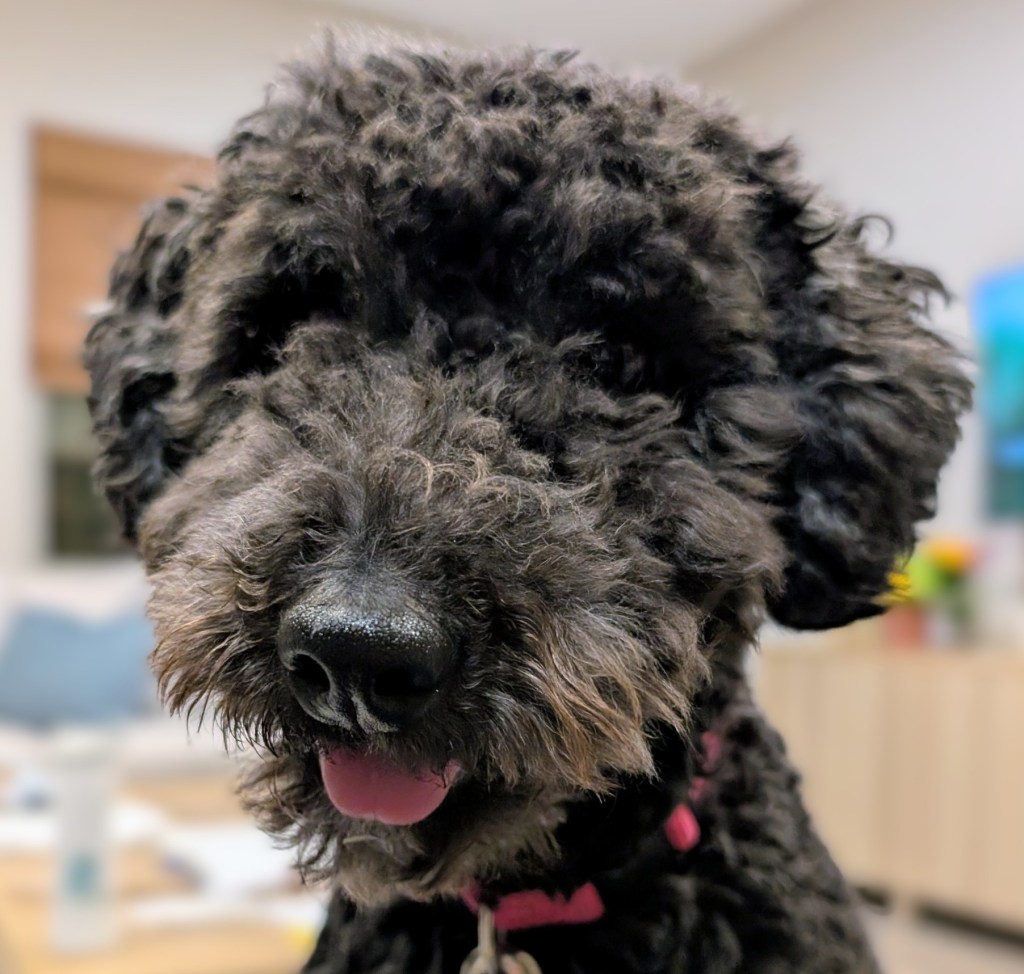
    At 66, having never raised a dog before and in a fit of (hopefully temporary) insanity, I decided that getting a puppy was a good idea. I further thought that having a “doodle” would be a great choice. All doodles are part poodle, and our Olive is mostly poodle, one of the smartest, most stubborn, and highest-energy dog breeds. So Olive came into my life last spring. I lost a fair bit of skin before she lost her puppy teeth, but she is now a fairly well-trained adolescent pup. Along the way, I have learned a lot about how to train and work with dogs, and I have also learned some new perspectives that help me think about my relationship with God in new ways.

    Not long after Olive and I started trying to train each other, I realized that I was saying the same things to Olive over and over again. As I think about the things I repeatedly say to Olive, I can easily imagine that God likely says many of the same things to me. And he likely repeats them even more often than I do. As I think about my relationship with Olive and God’s relationship with me, I find Olive teaching me some spiritual lessons.

    Don’t Think You Know What Is Best For You

    I often find myself exasperated that I can’t get Olive to believe that I know what is good for her and I want the best for her (though it may not be what she wants). I often tell her things like:

    • I am trying to help you. Why are you fighting me?
    • Why can’t you believe that I know what is best for you?
    • Why do you make everything so hard? Will you please just let me help you?
    • If you will just do what I say, you really will be happier!

    I certainly can imagine God repeating those same things to me. God loves me, knows what is good for me, and wants the best for me, but like a stubborn doodle puppy, I want what I want. He tells me in scripture, he tells me in prayer, he tells me through the Holy Spirit, and he tells me through the witness of my brothers and sisters, what is good for me, but it seems to take a terribly long time before I begin to act as if I really believe that he wants the best for me. Like my puppy is with me, I seem to have a hard time believing that God knows what is best for me.

    Stop Running Away

    Depending on her mood (and how tired she is), Olive seems to take great pleasure in running away from me. A fun game of fetch becomes a maddening game of “catch me if you can” with a twenty-pound doodle who is lightning quick. I find myself repeating:

    • Please stop running away from me
    • Can’t you just settle down?
    • See how nice it is when we just sit together!

    It is frankly embarrassing how often and how rapidly I run away from God. I know when he calls me. I know what he wants. But I am quick to dig into my bag of tricks to avoid him. Surely it would be better to check my email/social media/news feed/anything else, rather than turn to God. But that does not exhaust my bag of tricks. I can find any number of good, important, and useful “Christian” things to do to keep me from God. I can read my Bible without letting it speak to me. I can offer halfhearted prayers with no intention of hearing from God. I have a bookcase full of unread books I can use to avoid God.

    When I finally tire of running, I find that what God is calling me to is often nothing more than to be in his presence. As I say to Olive, it is quite nice to sit together. I am very glad that God is more patient with my running away than I am with Olives’.

    Stop Trying to Be “In Charge”

    Olive loves to take walks around our neighborhood. Most of the time, she remembers that the leash means she is not in control. In particular, she is not supposed to pull and strain against the leash. But because she is still a puppy, she sometimes forgets and starts pulling. When that happens, I stop. I don’t move forward again until she backs up enough for the leash to go slack. If she doesn’t respond, I slowly increase the tension on the leash, pulling her back to me, forcing her to make a U-turn. Eventually, Olive does turn back and makes eye contact with me, and I tell her she is a good puppy, and we start again to enjoy our walk together.

    If we know nothing else about God, we likely know that he is in charge; we are not. But how often do we assert our control, willfully “pulling on the leash,” determined to have things go the way we want? How do we react when we reach the end of the leash? Do we keep straining forward, determined to have it our way? How much easier it is when we, like Olive, turn around and check in with the one who is in control, relinquishing the authority we never had but were trying to assert.

    There Are Things We Cannot Understand

    One day, as I was standing at the kitchen sink washing a bunch of grapes, Olive gobbled up something off the floor at my feet. If you have a dog, you likely know that grapes, even in the smallest amount, can be very, very bad for it. Even worse, there are no external symptoms, but grapes can cause kidney failure in dogs. Not knowing what Olive had eaten, I had to assume it could have been an errant grape. So off we went to the emergency vet, where Olive was given an emetic and had her blood tested to baseline her kidney function, which had to be retested forty-eight hours later.

    Olive was suddenly thrust into a chaotic situation. One minute, she was just being her puppy self, and the next minute, she was scooped up and taken to a strange place where she was made to suffer painful indignities. She had no idea why all these things were happening to her. I couldn’t make her understand what was happening and why. She is a pretty smart pup, but she could not know what was happening and why; it was simply beyond her ability to comprehend.

    What about us? There are times when our worlds go suddenly sideways. Try as we might, we simply cannot understand what is happening and why. I do not mean to imply that when suddenly thrust into terrible situations, it must be God acting in to save us from some catastrophe, as I whisked Olive off to the vet. That would be absurd and wrong; it may be true sometimes, but certainly not always. Yet in those confusing, chaotic moments, we are tempted to think that God has abandoned us or does not care. That is equally wrong. God loves and cares for us, even when we are lost, confused, and completely unable to understand what is happening, just as I loved and cared for Olive when she was baffled by what was happening to her.

    Olive seems to simply accept that there are things she cannot understand. I can’t say the same for myself. It is hard for us to admit that we are limited and that there are things beyond our ability to comprehend. I think that when Olive was at the vet, it was easier for her because she was with me, someone she has come to trust to take care of her. Can we develop the same level of trust in God’s care, a trust that can carry us through life’s storms?

    Just Be Honest

    Olive is (mostly) guileless. When she is scared, I know it; her tail is between her legs, her ears are back, and she hides. When she wants to go outside, I know it; she aggressively rings the bells hanging off the patio door handle. When she wants to play fetch, I know it; she takes one of her toys, drops it at my feet, and sits there, looking at me and waiting. As I sit at my desk writing this, she is putting her paws on my lap, asking for attention. Olive is never shy about letting me know what she wants, even when it is something she cannot have.

    I wish I were always that honest with God. I tidy up my prayers. I make sure they sound pious enough. I don’t always ask for what I really want, thinking that it is not something to bother God with. How easy it is for us to forget that guile is pointless before God; he knows what we have done, how we are feeling, and what we want. And he wants us to bring our whole selves, our true selves, without guile, before him. He can love and save only the real us, not a fanciful version of ourselves that we think he’d prefer. Olive makes no pretense. That is a good lesson to learn.


    The gulf between Olive and me is infinitesimal compared to the gulf between God and me. My affection and care for her is nothing more than a pale shadow of the love and care my Father has for me. Nonetheless, if we pay attention to our relationship with our pets, we can see glimmers of our relationship with God. We can learn some important lessons. I wonder if I can take them to heart. Can you?



  • Extreme Makeover: Soul Edition

    Extreme Makeover: Soul Edition

    Do you remember the TV show “Extreme Makeover: Home Edition?” Or perhaps you have seen the current revival. I am most familiar with the original version which ran back in the early 2000s. When the show first started, they would fix up and renovate some deserving person’s home, making it much more livable. After a few seasons, the “renovation” had escalated to tearing down the old home and building a completely new one. That reminds me of how Jesus deals with our run-down and barely livable souls.

    It is not a far stretch to imagine the carpenter Jesus being in the home renovation business. We might call him in for some much-needed repairs. But we don’t realize that he is not content to fix the one or two things we think are the problem; he will continue the work until the whole structure is perfect.1

    In response to our request for repairs, he says, “You do know that I will find other things that need correction and I will fix those as well, don’t you? We will likely end up touching everything from the top of the roof all the way down to the foundation. Okay?”

    With cavalier bravado, we respond, “Yeah. Sure. Whatever. Listen, I just need the bathroom plumbing fixed and some new lighting in the family room. You can do that, can’t you?” We are certain that we know the extent of the repairs needed, even more than Jesus does.

    Jesus might caution us, “Of course I can do that, but you don’t really know what you are asking for.”

    If we do not stop him, our request for repaired plumbing and new lighting will lead to a new house, from the foundation up.


    New Life or Better Sin Management?

    Of course, Jesus is interested in us, not our homes. And he does not offer to improve us; he offers to make us new. We are in much worse shape than we know. He takes our wounded, damaged, malformed souls and makes them new. Not just improved, new. He said we must be born again,2 and we must start over from the beginning if we are to have a full and abundant life.3

    We don’t really know what we are asking for, especially when we first realize our brokenness and turn to God for help with our damaged natures. Jesus is in the new life business, not the life improvement business. But when we come to him, we are not looking for a new life; we are looking for an improved version of our current life. We don’t want the whole thing torn down and rebuilt from scratch; we just want him to improve the parts that are giving us trouble, or that we are starting to find odious.

    We may come to him saying, “Jesus, I get too angry too often, and I drink too much. Can you help me be less angry and get my drinking under control?”

    Knowing our deeper need, Jesus says, “Let’s work on that anger and the wounding that leads you to drink too much. Oh, hey! Here is something else I’ve noticed. You know, you’re kind of greedy and judgmental, too. That is part of what makes you angry. Let’s make you someone who loves and loves properly; someone who loves others even more than you love yourself. Then everything else resolves so much more easily.” He will make us into people for whom anger and drunkenness are simply unnatural and unattractive. We can become the kind of people for whom sin is not attractive.

    Jesus asks us to let him remake us in his image. He wants to make us perfect, as our Father in heaven is perfect.4 We can say, “no.” God will not go where he is not welcome. He may well help us with the anger and the drinking, but if we don’t let him fix the deep roots of our sinfulness, the results will almost certainly be like someone who patches up gaping drywall cracks without addressing the foundation issues that caused the cracking — the cracks soon reappear.

    Many of us approach our sinfulness like someone who puts up wallpaper to cover cracked plaster. It may look better, at least for a while, but the real problem has not been addressed. We’ve prettied things up so that the problems are not obvious, but the problems are still there. We take scripture like the fruit of the spirit in Galatians 55 as a behavioral to-do list. If we exhibit those qualities, then we will have life in the spirit. The fruit of the spirit is fruit; it is the result of or sign of a spirit-filled life; it does not make us spirit-filled. It is a description of life that is aligned with and formed by God’s spirit.

    Repentance Means Turning Around

    The Fruit of the Spirit, along with other biblical descriptions of new life, is God’s promise to us – “Invite me in, let me do my work, and this is what you’ll get.” It is an invitation to take up our crosses, to die to the world, and to live in Christ and let Christ live in us. Yes, sin is important. It can block the work of God (not because he is not omnipotent, but because sin generates shame that causes us to withdraw from God). Feeling guilty or telling God we are sorry is important, but it is just the starting point; confession (and forgiveness) is the unlocking and opening of the door of our hearts to the Father. Repentance is turning around and going back to wherever we first got off track and starting anew. For most of us, that is a process we will repeat again and again and again. But as we position ourselves to allow the Holy Spirit to re-form us from the inside out, we can and will start to bear the good fruit. We can have an extreme soul makeover.


    1. I am standing on the shoulders of giants. C. S. Lewis used this analogy in Mere Christianity, and tells us he borrowed it from George MacDonald. ↩︎
    2. John 3:3 ↩︎
    3. See John 10:10 ↩︎
    4. Matthew 5:48. ↩︎
    5. “But the fruit of the Spirit is love, joy, peace, forbearance, kindness, goodness, faithfulness, gentleness and self-control.”
      Galatians 5:22-23 (NIV) ↩︎
  • Paradoxes

    Paradoxes


    A light shines
    It warms
    It brings life

    A light shines
    It exposes my flaws
    It illuminates what I've hidden

    Fear and shame
    I build walls
    To hide my flaws and secrets

    Behind my walls
    In cold and darkness
    Life ebbs

    The light moves
    Seeking me
    Drawing me out

    It finds me
    I welcome the warmth
    Slowly I come to life

    Again
    My flaws exposed
    My brokenness laid bare

    More walls
    Always more walls
    To hide and protect

    Safely behind my walls
    Cold and darkness prevail
    Life is all but extinct

    My safety
    My protection
    Slowly kill me

    The light is life
    My walls are death
    To live I must die
  • Becoming Resilient in a Disruptive World

    Becoming Resilient in a Disruptive World

    I recently heard a reasonably good working definition of resilience: the ability to not be affected by or quickly recover from buffeting, disturbances, and so on. That definition put me put me in mind of walking through a forest. If you have ever walked through a forest where there are no trails, you know how hard is it to walk in a straight line. We are easily affected by “buffeting and disturbances.” We start off walking due north, and before we know it, we are off in a completely different direction. A fallen tree or a boulder blocking our way nudges us subtly off course. Traversing a slope drags us off to the left or right as we walk across it. Finding a place to cross a stream leads us further away from our intended course. We put our heads down to shield our faces from a blowing rain and soon we are hopelessly lost. Our sense of direction and our ability to walk in a straight line is notoriously not resilient!

    A compass can save the day for us, but only if we use it! And we must use it nearly constantly; we must know we are off course as close as possible to when it happens. The longer we trudge ahead without checking our bearing, assuming that we are holding our course reasonably well, the more likely we are to become lost. It would be folly to set your course and then check your compass only after an obvious challenge, buffeting, or disturbance. There are too many subtle variations in our direction; you would stand very little chance of ending up where you set out for.

    For Christians, the in-dwelling spirit of Christ is our compass. We set our course to follow Jesus’ way. As John Mark Comer teaches, the true north of a disciple is to spend time with Jesus, become like him, and do what he did.1 The world around us is our primordial forest. Social media algorithms, twenty-four hour news cycles, and the constant pressure to do more and be more all buffet us and disturb our way. If we go very far at all with out consulting our “compass” we will soon be far off our intended course. We need to constantly look to God in prayer to see if we are still true to our course.

    Nearly five hundred years ago Ignatius of Loyola described a daily prayer method, the Examen, that helps us learn to consult our “compass” at least daily. You will find many descriptions of the Examen on line,2 and at its core, the Examen includes:

    1. Quieting yourself so that you can be more receptive to hearing God’s voice.
    2. Recognizing that your day is a gift, and giving thanks accordingly
    3. Allowing Holy Spirit to guide you as you reflect on your day
    4. Assessing the thoughts, moods, and actions that drew us closer God or seemed to push away from God.
    5. Asking God to help you navigate the challenges of the next day.

    Most people pray the Examen daily and many pray it twice a day. But as Jim Manney points out in his book, “A Simple, Life-Changing Prayer: Discovering the Power of St. Ignatius Loyola’s Examen,” the ultimate fruit of a consistent practice of praying the Examen is to become people who are constantly aware of how they are being subtly pulled off course. We can become like people who always have their compass in hand, always checking and knowing the way we should be going.

    We can become spiritually resilient in a disruptive world. If we learn to frequently check our spiritual compass, then when we are buffeted or disturbed in our following the way of Jesus, we can quickly get back on course.


    1. www.practicingtheway.org/ ↩︎
    2. A great starting point is: https://www.ignatianspirituality.com/ignatian-prayer/the-examen ↩︎

  • Transforming Beliefs: Lessons from Inside Out 2

    Transforming Beliefs: Lessons from Inside Out 2

    I just watched Inside Out 2. It was a terrific movie.1 I am certain that many people, while being entertained, found the movie helpful. I struggle with anxiety, as do some I love dearly, and the movie helped to illustrate that struggle and give me some needed language and helpful imagery.

    The Power of Narratives

    Inside Out 2 contains a powerful message about how our narratives, the things we believe to be true about ourselves and others, are the building blocks of our sense of self. Early in the film Joy and Sadness visit the Belief System, where Joy deposits Riley’s memory of winning the hockey game and they watch in awe as that memory grows into a belief, “I’m a Winner,” which is woven into all of Riley’s other beliefs to make her who she is.

    Beliefs, or narratives, are created by us to interpret and weave together our experiences and memories. In large measure, they determine who we are. Our narratives tell us not only about ourselves, they also tell us what we believe to be true about the world around us. As depicted in the film, our narratives combine to create our sense of self; we use them to make sense of the world and our experiences in it.

    In the movie, Joy carefully curates Riley’s sense of self, allowing only “good” memories to grow into narrative.2 We don’t have that curation in our lives. Our stories are an amalgam of good and bad, ugliness and beauty, joy and sorrow, victory and humiliation, and pride and shame. We all experience all of those things and they become part of us via the narratives we create to interpret them and reconcile them with the complex mix that makes up our belief system.

    What do our narratives look like? We may, like Riley, believe we are good friends and we are winners. Or, perhaps some of these may ring true for you:

    • I am not safe in the world.
    • I am defined by my accomplishments.
    • I earn love (or rejection) by my behavior.
    • Others are not to be trusted.
    • If I work hard I will be rewarded.

    Of course, these are only examples but they give a taste of stories we tell ourselves to help make sense of our ourselves and our experiences.

    Already powerful and defining, the narratives we believe are even more powerful because we are usually ignorant of them and so, rarely if ever, examine them. Whether we are aware of these beliefs and narratives or not, they . But here is the thing, these narratives, that shape who we are and how we act and react, can be true or false. They can be toxic or tonic. They can build us up or tear us down. It is therefore important that we carefully and honestly examine our narratives, embracing the true and discarding the false.

    Narratives and Christian Formation

    Our narratives, both true and false, extend to what we believe about God and how he views us. When it comes to how they impact our souls, our God narratives can be life-giving or deadly. Spend a few minutes with the list below; ask the Holy Spirit to help you discern which of these narratives (or ones like them) you have incorporated into your belief system.

    • God loves me and nothing I can do can change that.
    • God is a harsh and demanding judge, rewarding me when I earn his favor and punishing my disobedience or lack of faith.
    • God is intimately concerned with every aspect of my life.
    • God is distant and indifferent to my day to day struggles.
    • I am a dearly beloved child of God.
    • I am a wretched sinners worthy of nothing but damnation.
    • God is a loving father, longing for the return of wayward children.
    • God is a tyrannical judge who is waiting for me to screw up so he can cast me away.
    • I must work my way into God’s good graces.

    As before, these are only examples. But It is important to understand the God narratives we have woven into our believe system; they can help or hinder our spiritual growth and maturity.

    Christian Formation is the long, slow process of becoming like Jesus; loving and obeying the Father and loving and serving each other as Jesus did. Like all of our other narratives, we rarely, if ever, examine our God narratives. We simply do not know what they are, where they came from, whether they are true or false, and how they are impacting our ability to follow Jesus.

    If we are living under a belief system that is woven from false narratives about God and ourselves, our process of formation is greatly handicapped. That is why many spiritual disciplines and practices are designed to help us form true narratives about God, who he is to us, and who we are to him. They teach us to open ourselves to God’s love and healing.3 Aided by the Holy Spirit, we experience God’s loving presence in our lives and, again with the aid of the Holy Spirit, we begin to rewrite the false narratives about God and reinforce the true ones.

    Where to Begin; How to Progress?

    Identifying and challenging our God narratives is not an easy task; it can be hard to even know where to start.4 We did not intentionally formulate our God narratives and we are not often aware of them. So how do we recognize them and find a path that leads us to true God narrative? Happily, there is a tool, the Enneagram of Christlike Virtues (ECV), that can help us identify those false narratives and beliefs and point us toward developing true narratives.

    You may be familiar with the Enneagram of Personality, a personality typing framework that has gotten a lot of traction in Christian and secular circles in recent years. It seeks to slot each person into one of nine personality types. The Enneagram of Christlike Virtues (hereafter ECV) recognizes that we are too complex to be defined by a single number and pulls us back from a system of personality types. The ECV looks instead at nine classical Christian virtues exemplified in the life of Christ.5 Each of the nine virtues has a corresponding deadly sin that is, at root, a corruption or turning inward of the virtue. For example, in the ECV, the virtue associated with number six on the Enneagram is “Courageous Obedience,” and the deadly sin is fear. The virtue grows out of a trust in ourselves to prepare for any problems that might arise, instead of trusting in God’s protection.

    Christ exemplifies each virtue and each sin is absent in his life. In our formation we aim for that goal; we are after all the virtues, not one or two. When we take this holistic approach, looking at all nine virtues and vices and seeing where each is evident in our lives, we can begin to see where we have false narratives that are hindering our growth. To continue the example, the false narratives that may drive us toward the sin of Fear and away from the virtue of Courageous Obedience are beliefs like: “I must never let _______ happen again,” “I am unsafe unless I am in control,” and “Everything will fall apart unless I _______.”

    The ECV framework can help us see where vices and virtues are evident in our lives, and for each vice or sin can help us see the false narratives about God and ourselves that may lie at the root of the vice. The framework also includes suggested spiritual exercises or disciplines and prayer focuses that can help us position ourselves to receive the Holy Spirit’s loving, restorative ministry.

    Even more importantly, the ECV identifies that Transforming Trusts need to help us grow from sin to virtue. The nine Transforming Trusts, and their associated misplaced trusts, help us see beliefs that are hold is back from the life God calls us to and light the way to the deeper trust in God that allows us to grow evermore like Jesus.

    At the end of Inside Out 2, Riley forms an integrated sense of self. Using insights from a tool like the Enneagram of Christlike Virtues along with classical spiritual disciplines and the guidance of qualified spiritual director, we can open ourselves to the transforming power of the Holy Spirit to weave into our self image all of the Christlike Virtues. If you interested in pursuing this channel of spiritual growth, please contact me or reach out to David Wu at Mosaic Formation.


    1. I know, I know, I’m late to the party, but better late than never. ↩︎
    2. Spoiler alert: That turns out to be a not so great strategy ↩︎
    3. For example, Prayer, Fasting, Lectio Divina, Solitude, and Silence. ↩︎
    4. I am thinking only about our God narratives here. That is not to say that we should ignore other false narratives that misshape us. A qualified therapist can be of enormous value here. ↩︎
    5. The history of the Enneagram is controversial and can be murky, but nearly all agree that its present form as a personality typology arose in second half of the 20th century. However, many centuries earlier Christian monks and theologians had enumerated “deadly” sins and counterpoint virtues, including a nine-point circular diagram of Christian virtues set down by Ramon Llull, a Franciscan theologian and mathematician in 1307. ↩︎
  • Fear Not

    Fear Not

    Let not your hearts be troubled, neither let them be afraid. Jesus

    The Bible repeatedly tells us not to be fearful or anxious.

    • Have I not commanded you? Be strong and courageous. Do not be afraid; do not be discouraged, for the LORD your God will be with you wherever you go.1
    • The LORD is with me; I will not be afraid.2
    • And [Jesus] said to them, “Why are you afraid, O you of little faith?”3
    • So don’t be afraid; you are worth more than many sparrows.4
    • Peace I leave with you; my peace I give to you. Not as the world gives do I give to you. Let not your hearts be troubled, neither let them be afraid.5
    • Do not be afraid, little flock, for your Father has been pleased to give you the kingdom.6
    • Do not be anxious about anything, but in everything by prayer and supplication with thanksgiving let your requests be made known to God.7
    • Therefore do not be anxious, … but seek first the kingdom of God and his righteousness, and all these things will be added to you. Therefore do not be anxious about tomorrow, for tomorrow will be anxious for itself. Sufficient for the day is its own trouble.8
    • Cast all your anxiety on [God] because he cares for you.9

    How do you feel reading those verses? If you skipped over them just now, go back and read them again, paying attention to how they make you feel. Are you comforted by them or are you convicted of your inability to trust God? It depends on how we are reading those verses. The lens through which we read scripture will greatly influence how we interpret what we read.

    Most of us were taught to view the Bible as a divine instruction book. If you do what it says, God will be pleased with you. If you fail to follow the instructions, God will at least be disappointed or, more likely, will be angry with you.

    If we view the Bible as a rule book, “Basic Instructions Before Leaving Earth,” we will see these verses as commands to not be afraid. Then, when we are afraid or anxious, we take it a sign of spiritual weakness and a lack of faith; we are not doing what God commands. With this mindset we believe that when we are anxious and afraid, we are going against God’s commands; it is a sin to be anxious and afraid.

    I used to think that way. I believed that when I was anxious or afraid, it was as a marker of how weak my faith was, of how little I trusted God. Believing my anxiety was, at best, a sign of spiritual immaturity, I would slather on a thick layer of guilt and shame. Of course that guilt and shame would just make me more anxious, believing that I was displeasing God.

    But as I have learned about the triune God and experienced his love for me, and as I have studied spiritual formation and sat with others in spiritual direction, I am convinced that the Bible is less about following the rules and is more about understanding God’s loving desire for us. In particular, the New Testament is not laying down a new law book to proscribe our behavior. Jesus is not Moses 2.0.10

    Jesus is the full revelation of a Father who loves us and wants us to be happy and well. What if we looked at those verses on anxiety and fear as the wisest of wise advice and as encouragements from someone who loves and cares for us and wants us to be happy?

    Instead of reading “do not be afraid” as a law to be obeyed, can we hear it as comfort and encouragement from a loving God? Can we hear a father, grieved not by disobedience, but by our unnecessary fear and anxiety. Consider the story of the storm-tossed boat in Matthew chapter 8. Read it slowly, imagine the scene with your mind’s eye. Pay particular attention to how you perceive Jesus.

    And when he got into the boat, his disciples followed him. And behold, there arose a great storm on the sea, so that the boat was being swamped by the waves; but he was asleep. And they went and woke him, saying, “Save us, Lord; we are perishing.” And he said to them, “Why are you afraid, O you of little faith?” Then he rose and rebuked the winds and the sea, and there was a great calm. And the men marveled, saying, “What sort of man is this, that even winds and sea obey him?”11

    How does Jesus seem to you? Is he frustrated with his disciples? Angry perhaps? If that is the case, I invited you to sit with the passage again, this time, imagine Jesus feeling how you might feel if your child was unnecessarily frightened by a storm; not angry, but a little sad that loved ones are needlessly distressed. Can you hear “O you of little faith” as a gentle chiding? Don’t hurry; stay with this reading a while.

    How you see Jesus in this parable is likely how you expect him to be if you come to him with your fears. What we perceive about God from our scripture reading has more to do with our preconceived image of him than with the words on the page.

    If you have learned that “fear not” is a command to be obeyed, and not an encouragement to a freer life, consider this exercise. Pick two or three of the scripture passages that you read as commands to greater faithfulness. Read it over slowly. Sit with it. Chew on it. Ask Holy Spirit to help you see words of love, encouragement, and even instruction, in place of commands to be brave (or else!). The Holy Spirit loves to show us the true picture of God, the God who does not condemn but loves, saves, and restores.


    1. Joshua 1:9 (NIV) ↩︎
    2. Psalms 118:6 (NIV) ↩︎
    3. Matthew 8:26 (ESV) ↩︎
    4. Matthew 10:31 (NIV) ↩︎
    5. John 14:27 (ESV) ↩︎
    6. Luke 12:32 (NIV) ↩︎
    7. Philippians 4:6 (ESV) ↩︎
    8. Matthew 6:31(a), 33-34 (ESV) ↩︎
    9. 1 Peter 5:7 (NIV) ↩︎
    10. And neither are Matthew, Mark, Luke, John, and Paul. ↩︎
    11. Matthew 8:23-27 (ESV) ↩︎

  • Chapter 23: Endings And Beginnings

    My time in My Pops’ Workshop was ending. I would still see it in visions from time to time for another year or so, but those were less times of transformation and more times of illumination and encouragement. I continued, for a time to be taught and coached by the Lord through visions, but that season too came to end.

    As I reflect on all that transpired in my Pops’ Workshop and all the healing that was begun there, I am literally awestruck. Looking through the lens of spiritual formation, drawing on what I learned when studying to be director and my on-going education and reading, I see three movements in play: Identity, Healing and Purpose.


    Identity

    My time in Pops’ Workshop started with identity. Who was God to me? Who am I to God? What was Father like? What about Jesus, could I understand him as a human and not just as part of the Godhead? And just what does the Holy Spirit do? More importantly, could I find, somewhere in the trinity, love and acceptance?

    Father

    I found a Father who loves me, whether I am covered in glory or covered in shame and who was was always ready to be with me. One of the unexpected aspects of my time in my Pops’ Workshop was the exposure of hurts I did not know I carried in my soul. My earthly father was neither the best nor the worst of fathers, but I never felt anything approaching unconditional love. That I knew. I had not realized that I had also carried a belief that I was a bother and my dad would rather that I not engage with him except on his terms and timing. As I spent time with my Pops, I was surprised that he always has time for me; if he was “busy,” he always dropped what he was doing to attend to me. When I am with him, I am the only things that mattered; he thinks of nothing but me and there is nothing else he needs to attend to. This was an incredibly freeing healing. I am not loved grudgingly or out of obligation. I am a dearly beloved son of the Father.

    Son

    I had experienced Jesus’ love for me even before my time in Pops’ workshop. Yet here again my soul was marked by hurts I did not know I was carrying. Without realizing it, I had come to believe that I was too damaged and broken to ever be of much Kingdom use. But I found Jesus accepting me and inviting me to join him in his redemptive work from “day one,” before we undertook any of my much needed inner work.

    I came into Pops’ Workshop believing that while Jesus loved me, he would love me better or differently if I cleaned myself up and got my act together. Seriously, I didn’t even like myself all that much, so how could Jesus? I didn’t expect that he would stand in the slime and muck of my fouled inner life and gladly take from me all the things that were polluting my soul. And I certainly didn’t expect him to take on my sin of pride.

    Holy Spirit

    The third person of the trinity remains mysterious for me. Holy Spirit was not readily visible, and my interactions with him were the hardest to understand and to unpack. This does not surprise me. We are born of the Spirit that Jesus compares to the wind, we hear it and feel it, but we do not know where it comes from or where it is going. My encounter with Holy Spirit was healing, humbling, empowering, confusing, and enlightening all at the same time. I remain awestruck that I glimpsed the inner work of the Holy Spirit.


    Healing

    The second moment of my time in My Pops’ Workshop was healing. I was healed spiritually and emotionally. The Greek word usually translated as “save” is sozo, and means to be rescued, healed, and made whole. By that definition I was saved in my time in the Workshop.

    With a better sense of who God is and who I am to him, I was able to let myself be known more fully to God, opening the door to healing and wholeness.


    Purpose

    One of the unexpected changes that flows out of healing and wholeness is a redirection of our hearts. Before I was in my Pops’ Workshop, I was my biggest concern. How could I get what I wanted?1 My number one question was, “what about me?”

    Slowly but surely, as Father, Son, and Holy Spirit were about their work of replacing my heart of stone with one of flesh and blood,2 my focus shifted to God and to others. It began a shift away from being largely indifferent to others and to genuinely caring for and about others. I moved from asking, “How can I get what I want?” to wondering how I can love others as Jesus loves them. How can I help them find their way to the healing God wants for them? How can I be a responsible subject in the Kingdom of the Heavens?


    Endless Iteration

    These movements are neither discrete nor linear. And they certainly are not a “once and done.” They frequently overlapped each other and I have iterated through each many times. I find this picture a helpful visualization.

    Three movements in my spiritual formation

    Even now, years later, I revisit my identity and my view of God. I learn anew and at a deeper level that my identity is rooted not in what I think, do, say, earn, or achieve but in in the reality that I am a dearly beloved child of the Father.

    My spiritual and emotional healing is also an ongoing project. Of all the interior ills that beset me, I cannot identify a single one that is completely cured. Those ills have been attenuated, some to a remarkable degree and some not nearly as much as I would hope, but they are all still there to some degree. I have heard testimonies from people whose particular addiction or interior corruption was instantaneously healed. I have no reason to doubt those accounts, but that experience is foreign to me. My mystic prayer experiences, profound though they were, began but did not complete inner healing. My time in my Pop’s Workshop laid a strong foundation but did not make me “all right.”

    Finally, my sense of calling and kingdom purpose continues to evolve and be refreshed. The broad outlines of what I am to be about seem to be well-established, but how I am to walk that out shifts over time. I write blog posts, not books. I preach much more often than I could have expected. I sit with others, offering them spiritual direction, but not in the numbers I thought I would. God is using the skills and knowledge I learned as a team and management coach in the information technology sector to help church leadership teams learn and grow. I am being used for kingdom purposes in ways that I would not have imagined ten years ago.


    Formation Boot Camp

    What Jesus was doing, I now know, was attending to my spiritual formation. My time in the workshop was a spiritual formation boot camp. Robert Mulholland defines Spiritual Formation as “a process of being formed in the image of Christ for the sake of others.”3 It is only after the fact, looking back that I can see that was exactly what was happening in my Pops’ Workshop. I was being lovingly restored and healed to uncover the image of Christ in me, for the sake of others. The work was not completed, but the foundations were laid. A boot camp is the beginning of training, not the end; my time in my Pops’ Workshop was intensive and extensive, and it marked a beginning. I am still learning, being healed, and made new, ever closer to the image of Christ we each carry.

    The gospels promise us a new life, one that is full and abundant; we are reborn. In Romans Paul declares that the gospel is the power of God for our salvation. We are saved from the power of sin and death, and we are rescued, restored, and healed of the ills that vex our souls. It was not until I believed these promises to the point of being dissatisfied with the shallow surface improvements I had managed to make to my old life that God could step in and offer true transformation. It was then that I could be transformed by the renewing of my mind.4


    What About You?

    What do you want? Are you unwilling to settle for a tidied up, somewhat improved version of your old life? Do you want a vibrant, spirit-filled new life? One of the hardest things for us to do is to trust that God is really who he says he is and that he really cares about and for us the way he says he does. I invite you to take the first small sip of trusting God, whatever that looks like for you. My journey began with sitting in stillness, trusting that God really did love me and would show me an expression of his love. That journey has taken me places I could not have imagined.

    How will your journey begin? Mostly likely with silence, solitude, and patient waiting. Perhaps you will be accompanied by a pastor, soul friend, or spiritual director who can help you spot the road signs along the way. One thing is certain: God has more in store for each of us than we could ever dare imagine and he is waiting for us to be with him so that he can bless us with new, full life.

    I pray that you will find the starting point of your journey. God will do the rest!


    1. Even though I didn’t know what I wanted! ↩︎
    2. Ezekiel 36:26 ↩︎
    3. M. Robert Mulholland Jr.. Invitation to a Journey: A Road Map for Spiritual Formation (Kindle Locations 158-159). Kindle Edition. ↩︎
    4. Romans 12:2 ↩︎