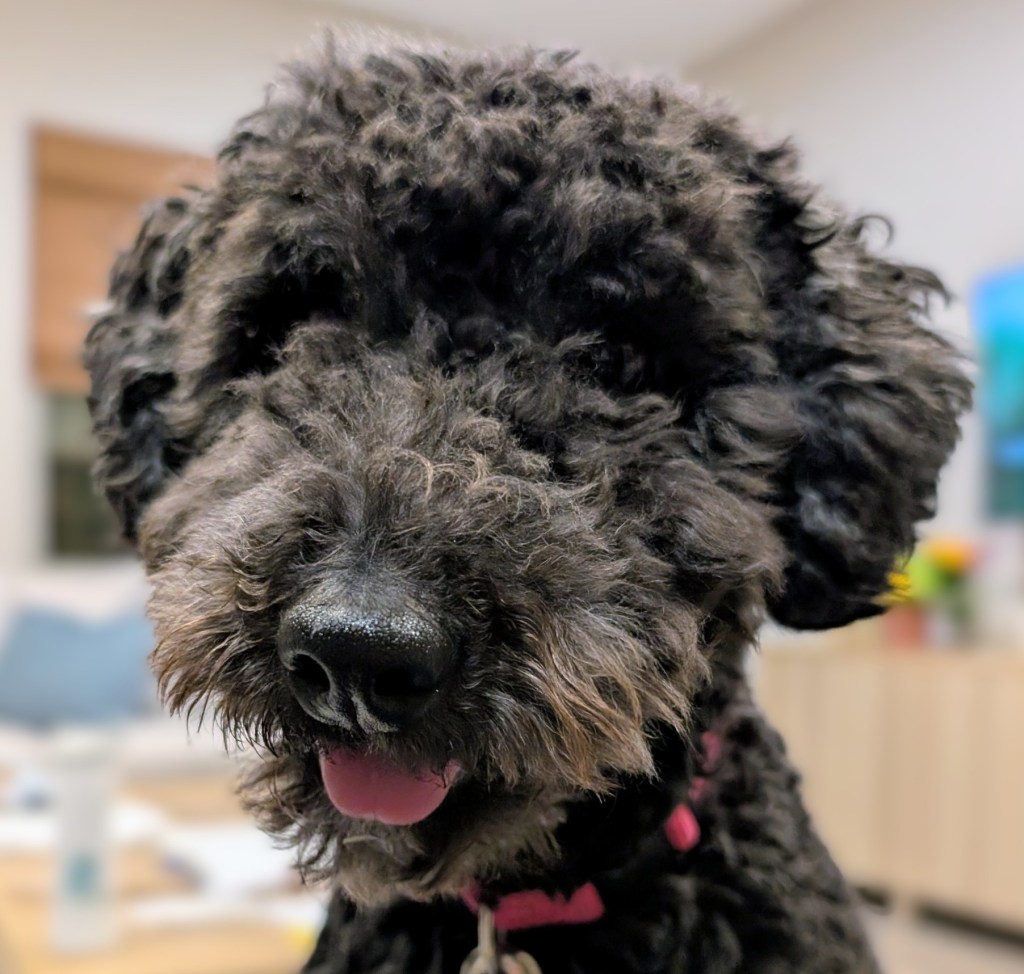
At 66, having never raised a dog before and in a fit of (hopefully temporary) insanity, I decided that getting a puppy was a good idea. I further thought that having a “doodle” would be a great choice. All doodles are part poodle, and our Olive is mostly poodle, one of the smartest, most stubborn, and highest-energy dog breeds. So Olive came into my life last spring. I lost a fair bit of skin before she lost her puppy teeth, but she is now a fairly well-trained adolescent pup. Along the way, I have learned a lot about how to train and work with dogs, and I have also learned some new perspectives that help me think about my relationship with God in new ways.
Not long after Olive and I started trying to train each other, I realized that I was saying the same things to Olive over and over again. As I think about the things I repeatedly say to Olive, I can easily imagine that God likely says many of the same things to me. And he likely repeats them even more often than I do. As I think about my relationship with Olive and God’s relationship with me, I find Olive teaching me some spiritual lessons.
Don’t Think You Know What Is Best For You
I often find myself exasperated that I can’t get Olive to believe that I know what is good for her and I want the best for her (though it may not be what she wants). I often tell her things like:
- I am trying to help you. Why are you fighting me?
- Why can’t you believe that I know what is best for you?
- Why do you make everything so hard? Will you please just let me help you?
- If you will just do what I say, you really will be happier!
I certainly can imagine God repeating those same things to me. God loves me, knows what is good for me, and wants the best for me, but like a stubborn doodle puppy, I want what I want. He tells me in scripture, he tells me in prayer, he tells me through the Holy Spirit, and he tells me through the witness of my brothers and sisters, what is good for me, but it seems to take a terribly long time before I begin to act as if I really believe that he wants the best for me. Like my puppy is with me, I seem to have a hard time believing that God knows what is best for me.
Stop Running Away
Depending on her mood (and how tired she is), Olive seems to take great pleasure in running away from me. A fun game of fetch becomes a maddening game of “catch me if you can” with a twenty-pound doodle who is lightning quick. I find myself repeating:
- Please stop running away from me
- Can’t you just settle down?
- See how nice it is when we just sit together!
It is frankly embarrassing how often and how rapidly I run away from God. I know when he calls me. I know what he wants. But I am quick to dig into my bag of tricks to avoid him. Surely it would be better to check my email/social media/news feed/anything else, rather than turn to God. But that does not exhaust my bag of tricks. I can find any number of good, important, and useful “Christian” things to do to keep me from God. I can read my Bible without letting it speak to me. I can offer halfhearted prayers with no intention of hearing from God. I have a bookcase full of unread books I can use to avoid God.
When I finally tire of running, I find that what God is calling me to is often nothing more than to be in his presence. As I say to Olive, it is quite nice to sit together. I am very glad that God is more patient with my running away than I am with Olives’.
Stop Trying to Be “In Charge”
Olive loves to take walks around our neighborhood. Most of the time, she remembers that the leash means she is not in control. In particular, she is not supposed to pull and strain against the leash. But because she is still a puppy, she sometimes forgets and starts pulling. When that happens, I stop. I don’t move forward again until she backs up enough for the leash to go slack. If she doesn’t respond, I slowly increase the tension on the leash, pulling her back to me, forcing her to make a U-turn. Eventually, Olive does turn back and makes eye contact with me, and I tell her she is a good puppy, and we start again to enjoy our walk together.
If we know nothing else about God, we likely know that he is in charge; we are not. But how often do we assert our control, willfully “pulling on the leash,” determined to have things go the way we want? How do we react when we reach the end of the leash? Do we keep straining forward, determined to have it our way? How much easier it is when we, like Olive, turn around and check in with the one who is in control, relinquishing the authority we never had but were trying to assert.
There Are Things We Cannot Understand
One day, as I was standing at the kitchen sink washing a bunch of grapes, Olive gobbled up something off the floor at my feet. If you have a dog, you likely know that grapes, even in the smallest amount, can be very, very bad for it. Even worse, there are no external symptoms, but grapes can cause kidney failure in dogs. Not knowing what Olive had eaten, I had to assume it could have been an errant grape. So off we went to the emergency vet, where Olive was given an emetic and had her blood tested to baseline her kidney function, which had to be retested forty-eight hours later.
Olive was suddenly thrust into a chaotic situation. One minute, she was just being her puppy self, and the next minute, she was scooped up and taken to a strange place where she was made to suffer painful indignities. She had no idea why all these things were happening to her. I couldn’t make her understand what was happening and why. She is a pretty smart pup, but she could not know what was happening and why; it was simply beyond her ability to comprehend.
What about us? There are times when our worlds go suddenly sideways. Try as we might, we simply cannot understand what is happening and why. I do not mean to imply that when suddenly thrust into terrible situations, it must be God acting in to save us from some catastrophe, as I whisked Olive off to the vet. That would be absurd and wrong; it may be true sometimes, but certainly not always. Yet in those confusing, chaotic moments, we are tempted to think that God has abandoned us or does not care. That is equally wrong. God loves and cares for us, even when we are lost, confused, and completely unable to understand what is happening, just as I loved and cared for Olive when she was baffled by what was happening to her.
Olive seems to simply accept that there are things she cannot understand. I can’t say the same for myself. It is hard for us to admit that we are limited and that there are things beyond our ability to comprehend. I think that when Olive was at the vet, it was easier for her because she was with me, someone she has come to trust to take care of her. Can we develop the same level of trust in God’s care, a trust that can carry us through life’s storms?
Just Be Honest
Olive is (mostly) guileless. When she is scared, I know it; her tail is between her legs, her ears are back, and she hides. When she wants to go outside, I know it; she aggressively rings the bells hanging off the patio door handle. When she wants to play fetch, I know it; she takes one of her toys, drops it at my feet, and sits there, looking at me and waiting. As I sit at my desk writing this, she is putting her paws on my lap, asking for attention. Olive is never shy about letting me know what she wants, even when it is something she cannot have.
I wish I were always that honest with God. I tidy up my prayers. I make sure they sound pious enough. I don’t always ask for what I really want, thinking that it is not something to bother God with. How easy it is for us to forget that guile is pointless before God; he knows what we have done, how we are feeling, and what we want. And he wants us to bring our whole selves, our true selves, without guile, before him. He can love and save only the real us, not a fanciful version of ourselves that we think he’d prefer. Olive makes no pretense. That is a good lesson to learn.
The gulf between Olive and me is infinitesimal compared to the gulf between God and me. My affection and care for her is nothing more than a pale shadow of the love and care my Father has for me. Nonetheless, if we pay attention to our relationship with our pets, we can see glimmers of our relationship with God. We can learn some important lessons. I wonder if I can take them to heart. Can you?



 From Pops' Workshop