Do you remember the TV show “Extreme Makeover: Home Edition?” Or perhaps you have seen the current revival. I am most familiar with the original version which ran back in the early 2000s. When the show first started, they would fix up and renovate some deserving person’s home, making it much more livable. After a few seasons, the “renovation” had escalated to tearing down the old home and building a completely new one. That reminds me of how Jesus deals with our run-down and barely livable souls.
It is not a far stretch to imagine the carpenter Jesus being in the home renovation business. We might call him in for some much-needed repairs. But we don’t realize that he is not content to fix the one or two things we think are the problem; he will continue the work until the whole structure is perfect.1
In response to our request for repairs, he says, “You do know that I will find other things that need correction and I will fix those as well, don’t you? We will likely end up touching everything from the top of the roof all the way down to the foundation. Okay?”
With cavalier bravado, we respond, “Yeah. Sure. Whatever. Listen, I just need the bathroom plumbing fixed and some new lighting in the family room. You can do that, can’t you?” We are certain that we know the extent of the repairs needed, even more than Jesus does.
Jesus might caution us, “Of course I can do that, but you don’t really know what you are asking for.”
If we do not stop him, our request for repaired plumbing and new lighting will lead to a new house, from the foundation up.
New Life or Better Sin Management?
Of course, Jesus is interested in us, not our homes. And he does not offer to improve us; he offers to make us new. We are in much worse shape than we know. He takes our wounded, damaged, malformed souls and makes them new. Not just improved, new. He said we must be born again,2 and we must start over from the beginning if we are to have a full and abundant life.3
We don’t really know what we are asking for, especially when we first realize our brokenness and turn to God for help with our damaged natures. Jesus is in the new life business, not the life improvement business. But when we come to him, we are not looking for a new life; we are looking for an improved version of our current life. We don’t want the whole thing torn down and rebuilt from scratch; we just want him to improve the parts that are giving us trouble, or that we are starting to find odious.
We may come to him saying, “Jesus, I get too angry too often, and I drink too much. Can you help me be less angry and get my drinking under control?”
Knowing our deeper need, Jesus says, “Let’s work on that anger and the wounding that leads you to drink too much. Oh, hey! Here is something else I’ve noticed. You know, you’re kind of greedy and judgmental, too. That is part of what makes you angry. Let’s make you someone who loves and loves properly; someone who loves others even more than you love yourself. Then everything else resolves so much more easily.” He will make us into people for whom anger and drunkenness are simply unnatural and unattractive. We can become the kind of people for whom sin is not attractive.
Jesus asks us to let him remake us in his image. He wants to make us perfect, as our Father in heaven is perfect.4 We can say, “no.” God will not go where he is not welcome. He may well help us with the anger and the drinking, but if we don’t let him fix the deep roots of our sinfulness, the results will almost certainly be like someone who patches up gaping drywall cracks without addressing the foundation issues that caused the cracking — the cracks soon reappear.
Many of us approach our sinfulness like someone who puts up wallpaper to cover cracked plaster. It may look better, at least for a while, but the real problem has not been addressed. We’ve prettied things up so that the problems are not obvious, but the problems are still there. We take scripture like the fruit of the spirit in Galatians 55 as a behavioral to-do list. If we exhibit those qualities, then we will have life in the spirit. The fruit of the spirit is fruit; it is the result of or sign of a spirit-filled life; it does not make us spirit-filled. It is a description of life that is aligned with and formed by God’s spirit.
Repentance Means Turning Around
The Fruit of the Spirit, along with other biblical descriptions of new life, is God’s promise to us – “Invite me in, let me do my work, and this is what you’ll get.” It is an invitation to take up our crosses, to die to the world, and to live in Christ and let Christ live in us. Yes, sin is important. It can block the work of God (not because he is not omnipotent, but because sin generates shame that causes us to withdraw from God). Feeling guilty or telling God we are sorry is important, but it is just the starting point; confession (and forgiveness) is the unlocking and opening of the door of our hearts to the Father. Repentance is turning around and going back to wherever we first got off track and starting anew. For most of us, that is a process we will repeat again and again and again. But as we position ourselves to allow the Holy Spirit to re-form us from the inside out, we can and will start to bear the good fruit. We can have an extreme soul makeover.
I am standing on the shoulders of giants. C. S. Lewis used this analogy in Mere Christianity, and tells us he borrowed it from George MacDonald. ↩︎
“But the fruit of the Spirit is love, joy, peace, forbearance, kindness, goodness, faithfulness, gentleness and self-control.” Galatians 5:22-23 (NIV) ↩︎
I just watched Inside Out 2. It was a terrific movie.1 I am certain that many people, while being entertained, found the movie helpful. I struggle with anxiety, as do some I love dearly, and the movie helped to illustrate that struggle and give me some needed language and helpful imagery.
The Power of Narratives
Inside Out 2 contains a powerful message about how our narratives, the things we believe to be true about ourselves and others, are the building blocks of our sense of self. Early in the film Joy and Sadness visit the Belief System, where Joy deposits Riley’s memory of winning the hockey game and they watch in awe as that memory grows into a belief, “I’m a Winner,” which is woven into all of Riley’s other beliefs to make her who she is.
Beliefs, or narratives, are created by us to interpret and weave together our experiences and memories. In large measure, they determine who we are. Our narratives tell us not only about ourselves, they also tell us what we believe to be true about the world around us. As depicted in the film, our narratives combine to create our sense of self; we use them to make sense of the world and our experiences in it.
In the movie, Joy carefully curates Riley’s sense of self, allowing only “good” memories to grow into narrative.2 We don’t have that curation in our lives. Our stories are an amalgam of good and bad, ugliness and beauty, joy and sorrow, victory and humiliation, and pride and shame. We all experience all of those things and they become part of us via the narratives we create to interpret them and reconcile them with the complex mix that makes up our belief system.
What do our narratives look like? We may, like Riley, believe we are good friends and we are winners. Or, perhaps some of these may ring true for you:
I am not safe in the world.
I am defined by my accomplishments.
I earn love (or rejection) by my behavior.
Others are not to be trusted.
If I work hard I will be rewarded.
Of course, these are only examples but they give a taste of stories we tell ourselves to help make sense of our ourselves and our experiences.
Already powerful and defining, the narratives we believe are even more powerful because we are usually ignorant of them and so, rarely if ever, examine them. Whether we are aware of these beliefs and narratives or not, they . But here is the thing, these narratives, that shape who we are and how we act and react, can be true or false. They can be toxic or tonic. They can build us up or tear us down. It is therefore important that we carefully and honestly examine our narratives, embracing the true and discarding the false.
Narratives and Christian Formation
Our narratives, both true and false, extend to what we believe about God and how he views us. When it comes to how they impact our souls, our God narratives can be life-giving or deadly. Spend a few minutes with the list below; ask the Holy Spirit to help you discern which of these narratives (or ones like them) you have incorporated into your belief system.
God loves me and nothing I can do can change that.
God is a harsh and demanding judge, rewarding me when I earn his favor and punishing my disobedience or lack of faith.
God is intimately concerned with every aspect of my life.
God is distant and indifferent to my day to day struggles.
I am a dearly beloved child of God.
I am a wretched sinners worthy of nothing but damnation.
God is a loving father, longing for the return of wayward children.
God is a tyrannical judge who is waiting for me to screw up so he can cast me away.
I must work my way into God’s good graces.
As before, these are only examples. But It is important to understand the God narratives we have woven into our believe system; they can help or hinder our spiritual growth and maturity.
Christian Formation is the long, slow process of becoming like Jesus; loving and obeying the Father and loving and serving each other as Jesus did. Like all of our other narratives, we rarely, if ever, examine our God narratives. We simply do not know what they are, where they came from, whether they are true or false, and how they are impacting our ability to follow Jesus.
If we are living under a belief system that is woven from false narratives about God and ourselves, our process of formation is greatly handicapped. That is why many spiritual disciplines and practices are designed to help us form true narratives about God, who he is to us, and who we are to him. They teach us to open ourselves to God’s love and healing.3 Aided by the Holy Spirit, we experience God’s loving presence in our lives and, again with the aid of the Holy Spirit, we begin to rewrite the false narratives about God and reinforce the true ones.
Where to Begin; How to Progress?
Identifying and challenging our God narratives is not an easy task; it can be hard to even know where to start.4 We did not intentionally formulate our God narratives and we are not often aware of them. So how do we recognize them and find a path that leads us to true God narrative? Happily, there is a tool, the Enneagram of Christlike Virtues (ECV), that can help us identify those false narratives and beliefs and point us toward developing true narratives.
You may be familiar with the Enneagram of Personality, a personality typing framework that has gotten a lot of traction in Christian and secular circles in recent years. It seeks to slot each person into one of nine personality types. The Enneagram of Christlike Virtues (hereafter ECV) recognizes that we are too complex to be defined by a single number and pulls us back from a system of personality types. The ECV looks instead at nine classical Christian virtues exemplified in the life of Christ.5 Each of the nine virtues has a corresponding deadly sin that is, at root, a corruption or turning inward of the virtue. For example, in the ECV, the virtue associated with number six on the Enneagram is “Courageous Obedience,” and the deadly sin is fear. The virtue grows out of a trust in ourselves to prepare for any problems that might arise, instead of trusting in God’s protection.
Christ exemplifies each virtue and each sin is absent in his life. In our formation we aim for that goal; we are after all the virtues, not one or two. When we take this holistic approach, looking at all nine virtues and vices and seeing where each is evident in our lives, we can begin to see where we have false narratives that are hindering our growth. To continue the example, the false narratives that may drive us toward the sin of Fear and away from the virtue of Courageous Obedience are beliefs like: “I must never let _______ happen again,” “I am unsafe unless I am in control,” and “Everything will fall apart unless I _______.”
The ECV framework can help us see where vices and virtues are evident in our lives, and for each vice or sin can help us see the false narratives about God and ourselves that may lie at the root of the vice. The framework also includes suggested spiritual exercises or disciplines and prayer focuses that can help us position ourselves to receive the Holy Spirit’s loving, restorative ministry.
Even more importantly, the ECV identifies that Transforming Trusts need to help us grow from sin to virtue. The nine Transforming Trusts, and their associated misplaced trusts, help us see beliefs that are hold is back from the life God calls us to and light the way to the deeper trust in God that allows us to grow evermore like Jesus.
At the end of Inside Out 2, Riley forms an integrated sense of self. Using insights from a tool like the Enneagram of Christlike Virtues along with classical spiritual disciplines and the guidance of qualified spiritual director, we can open ourselves to the transforming power of the Holy Spirit to weave into our self image all of the Christlike Virtues. If you interested in pursuing this channel of spiritual growth, please contact me or reach out to David Wu at Mosaic Formation.
I know, I know, I’m late to the party, but better late than never. ↩︎
Spoiler alert: That turns out to be a not so great strategy ↩︎
For example, Prayer, Fasting, Lectio Divina, Solitude, and Silence. ↩︎
I am thinking only about our God narratives here. That is not to say that we should ignore other false narratives that misshape us. A qualified therapist can be of enormous value here. ↩︎
The history of the Enneagram is controversial and can be murky, but nearly all agree that its present form as a personality typology arose in second half of the 20th century. However, many centuries earlier Christian monks and theologians had enumerated “deadly” sins and counterpoint virtues, including a nine-point circular diagram of Christian virtues set down by Ramon Llull, a Franciscan theologian and mathematician in 1307. ↩︎
And [Jesus] said to them, “Why are you afraid, O you of little faith?”3
So don’t be afraid; you are worth more than many sparrows.4
Peace I leave with you; my peace I give to you. Not as the world gives do I give to you. Let not your hearts be troubled, neither let them be afraid.5
Do not be afraid, little flock, for your Father has been pleased to give you the kingdom.6
Do not be anxious about anything, but in everything by prayer and supplication with thanksgiving let your requests be made known to God.7
Therefore do not be anxious, … but seek first the kingdom of God and his righteousness, and all these things will be added to you. Therefore do not be anxious about tomorrow, for tomorrow will be anxious for itself. Sufficient for the day is its own trouble.8
Cast all your anxiety on [God] because he cares for you.9
How do you feel reading those verses? If you skipped over them just now, go back and read them again, paying attention to how they make you feel. Are you comforted by them or are you convicted of your inability to trust God? It depends on how we are reading those verses. The lens through which we read scripture will greatly influence how we interpret what we read.
Most of us were taught to view the Bible as a divine instruction book. If you do what it says, God will be pleased with you. If you fail to follow the instructions, God will at least be disappointed or, more likely, will be angry with you.
If we view the Bible as a rule book, “Basic Instructions Before Leaving Earth,” we will see these verses as commands to not be afraid. Then, when we are afraid or anxious, we take it a sign of spiritual weakness and a lack of faith; we are not doing what God commands. With this mindset we believe that when we are anxious and afraid, we are going against God’s commands; it is a sin to be anxious and afraid.
I used to think that way. I believed that when I was anxious or afraid, it was as a marker of how weak my faith was, of how little I trusted God. Believing my anxiety was, at best, a sign of spiritual immaturity, I would slather on a thick layer of guilt and shame. Of course that guilt and shame would just make me more anxious, believing that I was displeasing God.
But as I have learned about the triune God and experienced his love for me, and as I have studied spiritual formation and sat with others in spiritual direction, I am convinced that the Bible is less about following the rules and is more about understanding God’s loving desire for us. In particular, the New Testament is not laying down a new law book to proscribe our behavior. Jesus is not Moses 2.0.10
Jesus is the full revelation of a Father who loves us and wants us to be happy and well. What if we looked at those verses on anxiety and fear as the wisest of wise advice and as encouragements from someone who loves and cares for us and wants us to be happy?
Instead of reading “do not be afraid” as a law to be obeyed, can we hear it as comfort and encouragement from a loving God? Can we hear a father, grieved not by disobedience, but by our unnecessary fear and anxiety. Consider the story of the storm-tossed boat in Matthew chapter 8. Read it slowly, imagine the scene with your mind’s eye. Pay particular attention to how you perceive Jesus.
And when he got into the boat, his disciples followed him. And behold, there arose a great storm on the sea, so that the boat was being swamped by the waves; but he was asleep. And they went and woke him, saying, “Save us, Lord; we are perishing.” And he said to them, “Why are you afraid, O you of little faith?” Then he rose and rebuked the winds and the sea, and there was a great calm. And the men marveled, saying, “What sort of man is this, that even winds and sea obey him?”11
How does Jesus seem to you? Is he frustrated with his disciples? Angry perhaps? If that is the case, I invited you to sit with the passage again, this time, imagine Jesus feeling how you might feel if your child was unnecessarily frightened by a storm; not angry, but a little sad that loved ones are needlessly distressed. Can you hear “O you of little faith” as a gentle chiding? Don’t hurry; stay with this reading a while.
How you see Jesus in this parable is likely how you expect him to be if you come to him with your fears. What we perceive about God from our scripture reading has more to do with our preconceived image of him than with the words on the page.
If you have learned that “fear not” is a command to be obeyed, and not an encouragement to a freer life, consider this exercise. Pick two or three of the scripture passages that you read as commands to greater faithfulness. Read it over slowly. Sit with it. Chew on it. Ask Holy Spirit to help you see words of love, encouragement, and even instruction, in place of commands to be brave (or else!). The Holy Spirit loves to show us the true picture of God, the God who does not condemn but loves, saves, and restores.
My time in My Pops’ Workshop was ending. I would still see it in visions from time to time for another year or so, but those were less times of transformation and more times of illumination and encouragement. I continued, for a time to be taught and coached by the Lord through visions, but that season too came to end.
As I reflect on all that transpired in my Pops’ Workshop and all the healing that was begun there, I am literally awestruck. Looking through the lens of spiritual formation, drawing on what I learned when studying to be director and my on-going education and reading, I see three movements in play: Identity, Healing and Purpose.
Identity
My time in Pops’ Workshop started with identity. Who was God to me? Who am I to God? What was Father like? What about Jesus, could I understand him as a human and not just as part of the Godhead? And just what does the Holy Spirit do? More importantly, could I find, somewhere in the trinity, love and acceptance?
Father
I found a Father who loves me, whether I am covered in glory or covered in shame and who was was always ready to be with me. One of the unexpected aspects of my time in my Pops’ Workshop was the exposure of hurts I did not know I carried in my soul. My earthly father was neither the best nor the worst of fathers, but I never felt anything approaching unconditional love. That I knew. I had not realized that I had also carried a belief that I was a bother and my dad would rather that I not engage with him except on his terms and timing. As I spent time with my Pops, I was surprised that he always has time for me; if he was “busy,” he always dropped what he was doing to attend to me. When I am with him, I am the only things that mattered; he thinks of nothing but me and there is nothing else he needs to attend to. This was an incredibly freeing healing. I am not loved grudgingly or out of obligation. I am a dearly beloved son of the Father.
Son
I had experienced Jesus’ love for me even before my time in Pops’ workshop. Yet here again my soul was marked by hurts I did not know I was carrying. Without realizing it, I had come to believe that I was too damaged and broken to ever be of much Kingdom use. But I found Jesus accepting me and inviting me to join him in his redemptive work from “day one,” before we undertook any of my much needed inner work.
I came into Pops’ Workshop believing that while Jesus loved me, he would love me better or differently if I cleaned myself up and got my act together. Seriously, I didn’t even like myself all that much, so how could Jesus? I didn’t expect that he would stand in the slime and muck of my fouled inner life and gladly take from me all the things that were polluting my soul. And I certainly didn’t expect him to take on my sin of pride.
Holy Spirit
The third person of the trinity remains mysterious for me. Holy Spirit was not readily visible, and my interactions with him were the hardest to understand and to unpack. This does not surprise me. We are born of the Spirit that Jesus compares to the wind, we hear it and feel it, but we do not know where it comes from or where it is going. My encounter with Holy Spirit was healing, humbling, empowering, confusing, and enlightening all at the same time. I remain awestruck that I glimpsed the inner work of the Holy Spirit.
Healing
The second moment of my time in My Pops’ Workshop was healing. I was healed spiritually and emotionally. The Greek word usually translated as “save” is sozo, and means to be rescued, healed, and made whole. By that definition I was saved in my time in the Workshop.
With a better sense of who God is and who I am to him, I was able to let myself be known more fully to God, opening the door to healing and wholeness.
Purpose
One of the unexpected changes that flows out of healing and wholeness is a redirection of our hearts. Before I was in my Pops’ Workshop, I was my biggest concern. How could I get what I wanted?1 My number one question was, “what about me?”
Slowly but surely, as Father, Son, and Holy Spirit were about their work of replacing my heart of stone with one of flesh and blood,2 my focus shifted to God and to others. It began a shift away from being largely indifferent to others and to genuinely caring for and about others. I moved from asking, “How can I get what I want?” to wondering how I can love others as Jesus loves them. How can I help them find their way to the healing God wants for them? How can I be a responsible subject in the Kingdom of the Heavens?
Endless Iteration
These movements are neither discrete nor linear. And they certainly are not a “once and done.” They frequently overlapped each other and I have iterated through each many times. I find this picture a helpful visualization.
Three movements in my spiritual formation
Even now, years later, I revisit my identity and my view of God. I learn anew and at a deeper level that my identity is rooted not in what I think, do, say, earn, or achieve but in in the reality that I am a dearly beloved child of the Father.
My spiritual and emotional healing is also an ongoing project. Of all the interior ills that beset me, I cannot identify a single one that is completely cured. Those ills have been attenuated, some to a remarkable degree and some not nearly as much as I would hope, but they are all still there to some degree. I have heard testimonies from people whose particular addiction or interior corruption was instantaneously healed. I have no reason to doubt those accounts, but that experience is foreign to me. My mystic prayer experiences, profound though they were, began but did not complete inner healing. My time in my Pop’s Workshop laid a strong foundation but did not make me “all right.”
Finally, my sense of calling and kingdom purpose continues to evolve and be refreshed. The broad outlines of what I am to be about seem to be well-established, but how I am to walk that out shifts over time. I write blog posts, not books. I preach much more often than I could have expected. I sit with others, offering them spiritual direction, but not in the numbers I thought I would. God is using the skills and knowledge I learned as a team and management coach in the information technology sector to help church leadership teams learn and grow. I am being used for kingdom purposes in ways that I would not have imagined ten years ago.
Formation Boot Camp
What Jesus was doing, I now know, was attending to my spiritual formation. My time in the workshop was a spiritual formation boot camp. Robert Mulholland defines Spiritual Formation as “a process of being formed in the image of Christ for the sake of others.”3 It is only after the fact, looking back that I can see that was exactly what was happening in my Pops’ Workshop. I was being lovingly restored and healed to uncover the image of Christ in me, for the sake of others. The work was not completed, but the foundations were laid. A boot camp is the beginning of training, not the end; my time in my Pops’ Workshop was intensive and extensive, and it marked a beginning. I am still learning, being healed, and made new, ever closer to the image of Christ we each carry.
The gospels promise us a new life, one that is full and abundant; we are reborn. In Romans Paul declares that the gospel is the power of God for our salvation. We are saved from the power of sin and death, and we are rescued, restored, and healed of the ills that vex our souls. It was not until I believed these promises to the point of being dissatisfied with the shallow surface improvements I had managed to make to my old life that God could step in and offer true transformation. It was then that I could be transformed by the renewing of my mind.4
What About You?
What do you want? Are you unwilling to settle for a tidied up, somewhat improved version of your old life? Do you want a vibrant, spirit-filled new life? One of the hardest things for us to do is to trust that God is really who he says he is and that he really cares about and for us the way he says he does. I invite you to take the first small sip of trusting God, whatever that looks like for you. My journey began with sitting in stillness, trusting that God really did love me and would show me an expression of his love. That journey has taken me places I could not have imagined.
How will your journey begin? Mostly likely with silence, solitude, and patient waiting. Perhaps you will be accompanied by a pastor, soul friend, or spiritual director who can help you spot the road signs along the way. One thing is certain: God has more in store for each of us than we could ever dare imagine and he is waiting for us to be with him so that he can bless us with new, full life.
I pray that you will find the starting point of your journey. God will do the rest!
“Everyone who drinks of this water will be thirsty again, but whoever drinks of the water that I will give him will never be thirsty again. The water that I will give him will become in him a spring of water welling up to eternal life.” John 4:13-14 (ESV)
Another thread that I find woven through my experiences in my Pops’ Workshop is water. Those experiences culminated in a vast lake that lies beneath my Pops’ Workshop and which became the scene of a powerful vision.
Water, Water, Everywhere
I am not surprised that water was an important element of my time in my Pops’ Workshop; it is a common motif in the Bible. Begining with Genesis, where river flows out of Eden to water the garden,1 water is woven through Israel’s history: Moses is drawn up out of the waters of the Nile;2 the Red Sea is parted to allow Israel’s escape from Egyptian bondage, and it rushes back to crush Pharaoh’s pursuing Army;3 God provides a miracle of water from a rock in the wilderness;4 and the Jordan river is miraculously parted to allow Israel to cross.5
The psalmist tells us that a man who delights in the Lord’s instruction is like a tree planted by streams of water,6 and Ezekiel’s exilic vision of the new temple describes a miraculous flow of water from the temple that brings life and abundance wherever it flows.7
The image of water continues in the New Testament. Jesus’s messianic destiny is revealed as the Spirit descends on him at his baptism in the waters of the Jordan River.8 Jesus describes the water he gives as a spring of water welling up to eternal life,9 and he promises that if we believe in him, rivers of living water will flow out of our hearts.10 The final chapter of the bible describes a river of life that flows out of the throne of God.11
The Water motif has already been central to my time in the workshop and the healing and renewing that my Pops was unfolding in my life. When I was warned, in the vision of venomous snakes, that the enemy would strike me, I was also shown a stream of healing water.12 Water was a central image of the inner healing I didn’t even know I needed. The stream below the workshop, which should have been a torrent of God’s love, was barely a trickle until Jesus guided me to bring my real self and my whole self to him for healing.13 That stream was also the home of my nemesis, “Pride Rock.”14 And, finally, the stream running through the meadow behind the workshop.15
Even with all those water images and references, there was one more yet to come.
The Lake
I was in a season of learning that seeking the workshop, or any other particular expression of God, is usually not productive; seeking the Lord is. When we chase after a particular expression of God, we are looking for something to scratch our spiritual itch. God is not generally in the business of scratching our itches. He wants us, and I find that usually means that when we approach God for what we can get from him, materially, emotionally, or spiritually, we are likely to be disappointed. It is when we approach him empty-handed and offer ourselves to his care that we are most likely to experience his presence, often in surprising ways!
In that season, after futilely seeking an experience of the workshop, I instead simply waited on the Lord, surrendering myself to his presence. Unexpectedly, I found myself back in the well — that is, down the hole at the back of the workshop, where I had experienced so much healing.
The stream there was now flowing, no longer obstructed and fouled. I had never thought about it before, but now it occurred to me to follow it to see where it went. I don’t know how long I followed it, but eventually I came to the mouth of the stream. It emptied into a sea or vast lake. Due to darkness or the size of the lake, I could not see the far shore. The shore where I stood was rocky, and the “beach” was smooth stones. I could not see the sky, and I had the impression that I was still underground, in a vast cave. The water was calm and sparkled beautifully with reflected light. I had the impression of moonlight, but couldn’t reconcile that with the feeling that I was in a cave.
The lake had no immediate meaning for me, except to underscore that I couldn’t expect that everything in the Workshop made sense as it would in a physical world. That was not the purpose of the visions I was experiencing in prayer. It made no sense that a stream running through a cave under an old workshop deep in the woods would empty out into a vast sea, perpetually bathed in moonlight. The purpose of this vision was to catch my curiosity, to make me wonder about this vast body of water that was somehow connected to God’s stream of live giving water.
Part of the answer came to me in the writing of C. S. Lewis, where he talked about going to the sea, but only dabbling in the shallows, being careful to stay anchored to the land.
This is my endlessly recurrent temptation: to go down to that Sea…and there neither dive nor swim nor float, but only dabble and splash, careful not to get out of my depth and holding on to the lifeline which connects me with my things temporal…Our temptation [in Christian discipleship] is to look eagerly for the minimum that will be accepted. We are in fact very like honest but reluctant taxpayers. We approve of an income tax in principle… We are very careful to pay no more than is necessary. And we hope — we very ardently hope — that after we have paid it there will still be enough left to live on…There is no parallel [in our life with God] to paying taxes and living on the remainder. For it is not so much of our time and so much of our attention that God demands; it is not even all our time and all our attention; it is ourselves…He will be infinitely merciful to our repeated failures; I know no promise that He will accept a deliberate compromise. For He has, in the last resort, nothing to give us but Himself; and He can give that only insofar as our self-affirming will retires and makes room for Him in our souls .16
God does not intend for us to give only so much of ourselves; the way of life is to give him all.
Months later, the imagery of the lake was still very much with me when I found myself praying about swimming and diving down deeper and deeper in the water, so deep that return to the surface would be impossible. This was not suicidal ideation; it was praying about what it could be like to join God in total surrender, reserving nothing for myself.17 In that time of prayer, my thoughts turned to the lake in the cave under Pop’s Workshop.
I realized that swimming out, away from shore, would have the same effect as swimming down. If you swam out, away from shore, not stopping until you were utterly exhausted, you would have reached a point of no return. You would have nothing left to give.
So, in that time of imaginative prayer, I swam out, under the starlit sky in the dark, cool water lake. As I reached that point, where I really couldn’t go any further, I saw a “hole” in the water. Like so many things in the workshop it defied the rules of logic and nature. It was not a whirlpool. It was more like swimming up to the edge of a waterfall, except the edge was circular. From every point water flowed down into the hole. I realized that I could swim “down” the waterfall, which I did. Soon I realized that I didn’t need to swim anymore. The force of the water carried me down. I did need my own strength. I stopped swimming and could be carried to where God wanted me to be.
I have since learned that is how it is with God. He does his best work when we surrender, when we cut the lifeline that holds us to all the things that would pull us away from him.
We like to say that we are “all in,” but we aren’t. We hedge our bets:
“Certainly God doesn’t care about consumerism; I tithe, that is good enough.”
Or, “Jesus could not have had my neighbor in mind when he said, ‘love your neighbor.’”
Or, “Sure, I lose my temper and say somethings I shouldn’t, but I never hurt anyone, so that’s okay.”
Or, “God doesn’t expect me to be perfect,18 that isn’t realistic.”
We exhaust ourselves trying to make sure we are “good enough,” and realize the folly of trying to simultaneously be who we want to be and who we think God wants us to be. When we stop rationalizing and finally let go and let God have his way with us the real transformation happens. God’s indwelling Spirit can do his truly miraculous work. He can remold us from the inside so that we care about consumerism, we love even the vilest neighbor, are filled with God’s peace, and, yes, he loves us enough to perfect us.
The lake was a picture of the refreshing vastness of God, and it became an invitation to let go of my old life so that God could give me my real life.
I did not know it beforehand, but I was reaching the beginning of the end of my time in my Pops’ Workshop. A new phase, which would be the last, was beginning. Looking back, I can see three broad movements in my time in my Pops’ Workshop: identity and invitation, healing and wholeness, and calling and sending.
The first movement was about identity and invitation. I learned who I am to God and who God is to me. I began the long and still-ongoing process of learning to trust him and yielding myself to his will. Understanding who I am to God meant understanding that I have purposes I never would have guessed.1 I was invited to be a small part of the healing and restoration Jesus brings through the ministry of the Holy Spirit and I was invited to bring words of peace and wholeness.
The second movement, my time with the Holy Spirit and my time below the Workshop, focused on my healing and wholeness. I had been promised both peace for my soul and attacks by the enemy, with the assurance that any hurts would be put right. I had taken an inward journey, discovering how the hurts and pain I stuffed down and tried to ignore had damaged my soul and were crippling my ability to share the life-giving waters of Christ-life. Jesus had come alongside me and invited me to bring my hurts, doubts, and sinful attitudes to him. I began the long, continuing journey toward soul wholeness.
A third movement was now starting; It was a movement of calling and sending. In some ways this was an echo and amplification of earlier the earlier invitations to help Jesus sand and polish to reveal inner beauty, to somehow facilitate the Holy Spirit’s internal work, and make God’s promise of peace widely known.
As this third movement unfolded, the way I experienced the workshop was also changing. Up to this point, my time in the workshop formed a fairly linear, coherent narrative, which made for easier writing. My experiences in the Workshop were becoming more like self-contained lessons, though the same lesson was often revisited. My “visits” were becoming shorter and more a distinct point. As I look over my journal entries for the remainder of my time visiting my Pops’ Workshop, it is much harder to tease out any kind of narrative. Accordingly, from this point onward, I will share my time Pops’ Workshop thematically and not necessarily share encounters in the order they happened.
Being
Even as the end was beginning, there were still some important lessons I needed to learn. In a direction session my director reminded me that much of what happened in the Workshop was Jesus healing, shaping, and forming me. That seems obvious to me now, but then it was something that was not front of mind. I simply didn’t notice what had happened and what was happening, especially where my interior state was concerned. We talked at length about just “being” with emotions and thoughts. He encouraged me to set aside analysis in favor of experiencing what was happening in the moment.
I had (and often still have) an unhealthy predilection to question and analyze my thoughts and emotions, novel ones in particular. Given the unpredictable environment of my youth that is not very surprising. I had developed a finely tuned analytical engine that had helped to protect me. Retreating inward in analysis helped me see where danger could be brewing and it also took me mentally and emotionally out of traumatic situations. I built a sturdy wall. Instead of the healthy processing of emotion, I learned avoidance. I stuffed it, either down the hole or hidden away, not to be recovered. In either case, I had learned not to be present to unpleasant and stressful situations.
As is often the case, the defensive mechanisms we craft in our youth are not helpful to us later in life. My inward withdrawal and shutting down was not limited to unpleasant emotions or frightening situations. I had taught myself to use analysis to pull back from unpleasant and stressful situations, emotions, and thoughts. But my defense mechanism was not selective. It applied to all situations, emotions, and events, whether they were good or bad, pleasant or unpleasant, sacred or profane. Every emotion, good or bad, that stirred me and every thought that came to my mind had to be understood. What did it mean? What did I need to do about it? What action was necessary?
Focusing on critical analysis and working out the next step, usually a defensive step, kept me from being present to what was happening. I was mainly unaware of the breadth and depth of what God was doing to me, in me, and for me. Instead of receiving and being present to God’s grace, I was racing ahead to see what “it” meant and what I should do next.
The action of analysis, the effort to try to understand and make sense of something, necessarily removes us from the experience we are seeking to understand We stop being participants and start being observers. For me, the most tragic instance of this is failing to be present to moments of transcendant joy. Rather than simply be in that moment, I would detach, taking myself out of the moment, to think about how that feeling of joy came about, how I could maintain it, and how I could get it again in the future. It was like seeing a beautiful sunset beginning to unfold and running into the house to check all the astronomical and meterogical conditions that caused to occur so that I could better understand it and vainly believe I could anticipate and “be ready” for the next one, all the while missing the beauty in front of me.
For many things, especiallythe things of God, the greatest and perhaps only value, is being present in the moment. The only time we can experience God is in the present moment. We can remember how he was present in the past, but we cannot experience him in the past. We can dream and imagine how he might be present to us in the future, but we cannot experience him in the future. The only time we can be present to God is in this moment. When we take ourselves out of the present moment because we are afraid, uncomfortable, or as a learned defense, we take away the possibility of being aware of God and seeing his activity in and around us.
My director’s advice was wise. I needed to learn to set aside analysis in favor of experiencing what was happening in the moment.
Pride goeth before destruction, and an haughty spirit before a fall.
Proverbs 16:18 (KJV)
My experience in My Pops’ Workshop began in late February. It was now the end of May; I was three months into this mystic journey. Praying on what was the morning of Pentecost Sunday, I returned to the workshop. Jesus and Pops were both quite busy, seemingly hard at work. I thought this odd since it was the Sabbath, I would have expected them to be at rest. Looking back on it, it shouldn’t have seemed odd since Jesus often healed on the Sabbath, and I was coming to the understanding that my time in my Pops’ Workshop was a time of healing.
Pops’ workshop was beginning to feel comfortable. I should have felt comfortable because I was in the hands of Love; that was not the case. I was becoming comfortable because I believed that I understood the workshop. Even worse, I was starting to think that I could manage what happened there. I imagined I could come and go as I pleased and encounter God when I wanted to and on my terms. Thinking that we can somehow manage God and his actions is patently absurd and is the height of vanity.
Nonetheless, that is where I found myself that Sunday, in the Workshop with my own agenda: I was hoping to just hang out with God. I aimlessly lounged around a bit and started getting uncomfortable. As my Pops continued his work, I felt awkward and out of place, like someone who blundered into the wrong meeting. After a short while, Pops broke the awkward silence, “Don’t you have some work to do with Jesus?”
Doing “work” with Jesus was not on my agenda; I was there to chill with the creator, redeemer, and sustainer of all that is. But my Pops’ tone of voice was firm, and his meaning was clear. I was not in charge of this situation, and I had not been given the grace to once again return to the Workshop so that I could lol around and expect to have God on my terms. He was not asking; he was telling me that I had more work to do.
Called to my senses, I dutifully headed back to where Jesus was busy sanding. He, too, seemed too busy for idle conversation. As I watched Jesus’ careful and attentive work, I started to get a slightly giddy feeling; I was starting to sense this would not be the casual workshop encounter I had hoped for. I was there for a purpose.
In my prayer, I asked Jesus to teach me to sand; I gave the Holy Spirit permission to have my mind, thoughts, tongue, and ears, and I thanked him for the work he was doing in me. Reviewing this encounter now, years later, I am struck by my own lack of activity. My Pops had just told me I had work to do, and yet, in my prayer, I sought to be a passive recipient of who knows what. That attitude belies a truth about spiritual formation and transformation. It isn’t something that happens to us while we sit passively doing nothing. God’s transforming grace is, in fact, all grace; we can do nothing to cause it to happen outside of God’s action, but we must be active participants. We show up, and we cooperate. We engage in practices that open us to his grace and power. Paradoxically, it is all God’s grace, and we have work to do. Our effort, puny though it be, is necessary.
Back Down the Hole
After my prayer for passive assistance, as I sat in the workshop, I knew why I was there. I was supposed to go back through the hole in the floor, down into the well. I resisted and, for a while, pretended I didn’t know what I was there for. Eventually, I surrendered, and down I went.
I was surprised to see the subterranean stream. When I last saw it, it had been barely a trickle—more like a seep. Now it was flowing—it really was a stream. Not only was the water starting to flow in earnest, but much of the muck and slime that had coated everything on the floor of the “well” had been washed away. I was astonished by this improvement, but I shouldn’t have been. The water, God’s love, the water of new life, was washing away the pollutants that tainted my inner life. This was yet another depiction of the changes God was making in my inner being.
I had resisted returning to the well, dreading the unpleasant work of confronting my brokenness. But now that I was there, I could see one of the reasons I was called back down: to receive encouragement. I had already made noticeable progress in unclogging the flow, and I may not have as much muck to clean up as I had feared. That encouragement was welcome. As I looked around a bit, I literally saw the other reason I had been summoned back down the hole and what my Pops had meant when he said, “Don’t you have some work to do with Jesus?”
Pride Rock
In the middle of the stream stood an enormous rock. I had not noticed it when I had been down the hole before, but much was clearer to me now. The “cave” under the workshop seemed brighter. I was certainly less ominous and oppressive. But this large rock was both ominous and oppressive. There was nothing encouraging about it. Other rocks I had encountered in the hole were about the size of a basketball or a little bigger. Big and heavy, but something I could manage to pick up and bring to Jesus. This rock was three or four feet tall. It had a broad base and came to a wicked spike at the end. I asked the Holy Spirit what this rock was, and after a short while, I heard a single word, “pride.”
This rock, Pride, was so striking and seemed so important to me that I sketched it in my journal. Here is a reproduction of that sketch.1
“Pride rock” was a new challenge. Unlike the other rocks I had encountered, it resisted all efforts to shift it out of the stream. I tried several times to lift it, and when that failed, I tried to push it over and out of the stream. It wouldn’t budge. This Pride, which stood blocking the flow of water, was intractable.
I shouldn’t have been surprised that the biggest, most ominous, hardest-to-move rock would be Pride. I had previously started clearing the rocks of fear, doubt, inadequacy, and shame by bringing those parts of me to Jesus. But pride was foundational to my being. Feelings of fear, doubt, and inadequacy were potent because they threatened my Pride; Pride empowered and activated those unhealthy feelings. If you had known me, you might have guessed that I had a fragile ego. So fragile, in fact, that fear, doubt, and feelings of inadequacy could not be tolerated. A large, immovable Pride was needed to protect myself. When any of the intolerable feelings arose and were metaphorically chucked down into the well, my Pride grew and swelled, vainly hoping to protect me from the next onslaught of insecurity.
It is hard to open the Bible without finding an admonition or warning against pride or encouragement to pride’s opposite, humility:
You rescue the humble, but you humiliate the proud.2
Pride goes before destruction, and a haughty spirit before a fall.3
Pride ends in humiliation, while humility brings honor.4
Human pride will be brought down, and human arrogance will be humbled. Only the LORD will be exalted on that day of judgment.5
His mighty arm has done tremendous things! He has scattered the proud and haughty ones. He has brought down princes from their thrones and exalted the humble.6
Blessed are the poor in spirit, for theirs is the kingdom of heaven.7
For those who exalt themselves will be humbled, and those who humble themselves will be exalted.8
This should not surprise us. Pride is at the root of most of our other sins. We lie, cheat, become angry, covet, steal, dishonor others, and even kill to protect our egos and our pride. We think we deserve whatever we want simply because we are “us” and want it.
In his masterwork of apologetics, Mere Christianity, C. S. Lewis devoted an entire chapter to “The Great Sin,” pride. He begins his treatise on pride by calling out its primacy.
According to Christian teachers, the essential vice, the utmost evil, is Pride. Unchastity, anger, greed, drunkenness, and all that, are mere fleabites in comparison: it was through Pride that the devil became the devil: Pride leads to every other vice: it is the complete anti-God state of mind.
Lewis, C. S.. Mere Christianity (C.S. Lewis Signature Classics) (pp. 121-122). HarperCollins. Kindle Edition.
He calls Pride a spiritual cancer that “eats up the very possibility of love, or contentment, or even common sense.”9 Pride is essentially competitive. We want to believe we are, in some dimension, better than our neighbor. We aren’t satisfied with just a good car that provides safe and reliable transportation. We want a car better than our neighbor’s. We want a car that will show others how rich, up-to-date, or clever we are. If cars aren’t your thing, we can just as easily substitute house, vacation, income, spouse, children, etc. We feel good about ourselves when we believe we are better than others, and they know it. We feel dissatisfied knowing that others are better than us.10
Pride gets no pleasure out of having something, only out of having more of it than the next man. We say that people are proud of being rich, or clever, or good-looking, but they are not. They are proud of being richer, or cleverer, or better-looking than others. If everyone else became equally rich, or clever, or good-looking there would be nothing to be proud about. It is the comparison that makes you proud: the pleasure of being above the rest.
Lewis, Mere Christianity (p. 122).
We see this sense of competition coming into play in the earliest instances of pride, which, not coincidentally, is also when sin entered the human condition. In the account of the fall of humankind told in Genesis,11 the enemy of our souls appeals to our pride to inspire the mother of all other sins. Adam and Eve are told that they are missing out; God is holding out on them. They are not getting what they should have. God has something you don’t have. What is it besides pride that leads us to say, “Yes, even though that is forbidden to me, I want it, and therefore, I shall have it?” Pride is at the root of our separation from God and at the root of all our sin.
Happily, there is an antidote or counterpart to Pride: Humility. We often think of humility as “not thinking too highly of one’s self; of having a proper perspective of our place.” That is not a bad way to think of it, but Lewis offers a helpful amplification, telling us that a truly humble person “will not be thinking about humility: he will not be thinking about himself at all.”12
If pride is the root of all sin, is its counterpart, humility, the root of all virtue? Our first thought may be: “Is it not true that Love is the most important virtue?” The answer is yes. Jesus affirms the Old Testament’s teaching that “to love God is the greatest and first commandment.”13 In his first letter to the Corinthians, Paul intimates that the greatest virtue is Love.14 God is Love15, and Jesus gives his followers a new commandment, to love one another.16 How, then, could Humility be greater than Love?
There is a Latin phrase, incurvatus in se, which means to be curved inward on oneself. That is not a bad way to think about pride. The proud man thinks only about himself, and the humble man thinks only of others. It is not just our attention and thoughts that can become distorted to curve back on ourselves. Love, too, can be bent in the wrong direction. We find ourselves loving ourselves where we should love God and our neighbors. We are made in love to love others, but in our sinful pride, our love is curved inward and we become the object of our own love.17 Pride deflects our love; humility sets it back on its proper path.
In the workshop on that Pentecost morning, I was still faced with the enormous problem that I now knew to be my pride. I had tried to move it but failed utterly. I asked Jesus to move it for me and, unsurprisingly, saw that he was down in the well with me. I was embarrassed to have him in my muck (my pride was showing), but he didn’t mind it all. It seemed as if he had been waiting for me to ask for his help. He did not offer to take this rock away, as had done for the other, smaller and now seemingly inconsequential rocks; He offered to smash the rock of pride into tiny pieces.
Immediately, I remembered a friend’s Holy Spirit experience. He had been completely overwhelmed by the spirit in a very public way such that he could do nothing but lay on the floor and yell “FIRE.” Is that what Jesus was offering me: what seemed like a public humiliation? It could have been the enemy trying to dissuade me, but I think this memory was a loving reminder to make sure I knew what the offer to smash my pride could entail. Jesus hadn’t offered to gently break the rock into manageable pieces. His offer was to smash my pride.
I was not sure I was willing to have a “FIRE” experience.18 However, I was sure that I wanted Pride Rock gone and that I couldn’t shift it myself. As I closed my prayer time on that Pentecost Sunday, I gave the Holy Spirit permission to do whatever was necessary to shift the rock of my pride out of the flow of Jesus’ love. That left me feeling uneasy and more than a bit nervous. “Whatever” is a very big word.
Another Side of Pride
I was soon to encounter my “Pride rock” again. It was exactly two weeks later, again on a Sunday morning. I had been noticing a pattern of God speaking to me through corporate confession in church. That is what happened that day. As we paused for silent reflection during our corporate confession, the word “Selfish” was being impressed upon me. This was not a gentle suggestion. It was an insistent, almost shrill voice, ringing over and over in my mind: “Selfish.”
This certainly got my attention. As I considered that word, I became aware of several areas of my life where I was being very selfish indeed. I had been in a funk because things were not turning out the way I wanted. I wanted what I wanted without thinking about what others might want or need, and I was sulking and feeling sorry for myself when I didn’t get my way.
I hadn’t really thought much about my experience with Pride Rock, but now, my thoughts jumped back to it. I was again down in that subterranean space, seeing that frightful rock. As I watched, it was lifted up, and I could see the underside of it, where the word “selfish” was written. I hadn’t considered selfishness as another aspect of pride, but now I had to confront it.
One aspect of pride is that of the preening peacock, caring too much about what others think of you and desiring to look good in the eyes of others. That is inherently a selfish desire. It has no value except to make you feel good about yourself. Another aspect of pride was being brought to my attention. In my pride, I cared only for myself. My incurvatus in se, was on full display. I was turned completely inward, neglecting my obligation to love my neighbors as myself. That was a needful reminder I need to hear most days.
During a session with my spiritual director, I remembered how I almost exhausted myself trying to move “pride rock” before I asked Jesus to help me with it, and then I was anxious about what that help might look like. As my director and I waited in silence, Jesus made me an offer that shocked me. He suggested that I go hang out in the meadow, just enjoying the long grass, warm sun, and cool breeze, while he goes down in the hole and takes care of “pride rock.” There was no angst, no sense of me having to endure anything or be embarrassed. He would simply take care of it.
I do not know what might have happened had I given unambiguous permission for Jesus to “smash” my pride. At that stage in my journey, I did not yet trust the Lord’s goodness. Jesus is, and has been, slowly “taking care” of my pride. But my pride is still with me. If I saw Pride Rock today, I imagine it would be smaller, certainly less sharp, and perhaps pushed a bit to the side, blocking less of the flow of life-giving water. My struggle with pride is ongoing and will continue to the end of my days. However, knowing that I am prideful is the best antidote and is the beginning of humility.
A Postscript
This “chapter” was extraordinarily hard to write. It stopped my progress on this book for years. I often worked on it then put it back down, not really knowing what to do with it.
It was hard for at least three reasons. The first reason is simply pragmatic. My time under the workshop was, in some ways, a pivot point. Much of what happened before was to prime me for my interior work and much of what was to come flowed out of it. That realization nearly always gave me pause.
Second, it is a very personal account and in many ways I find it embarrassing. I do not say it is right that I should feel embarrassment about my struggle with pride; ironically, it is pride rearing back up that makes writing about my pride difficult!
The third reason this chapter kept stopping my progress is that it is a reminder that the work begun below the workshop, nearly 10 years ago now, is still far from over. That, too, is embarrassing, to how much work I still have to do. I still stuff emotions and disappointment, finding it easier to ignore my feelings than to understand them and, when needed, sit with Jesus with them. Pride remains with me; less commanding and less prominent but still a part of who I am.
As hard as this chapter was to write, I hope it was not so hard to read.
I really like the AI-generated version used as the featured image of this post, but nonetheless, this simple drawing is closer to what was in my journal that day. ↩︎
It is worth noting here that there is nothing inherently wrong with having a nice car, home, income, etc. It is a problem if we value those things because they feed our pride by making us feel that we are somehow better or more deserving than others who have less (of material things). ↩︎
Michael Reeves gives an excellent exposition of this thought in chapter 3 of his book, Delighting in the Trinity: An Introduction to the Christian Faith. ↩︎
The person who had the “FIRE” experience did not, to my knowledge, ask for it or grant permission. ↩︎
One: It is so very dark. I know that you’ve been out in the light. Can you tell me about the light? What is it like when the sun rises?
Two: We’ve talked before about the light and the breaking of dawn; I don’t think there is much I can tell you that you haven’t heard before. You really need to experience it. If you’d like to come and walk in the desert and experience the sunrise, I am happy to accompany you.
One: I’m not really comfortable going out in the dark; it doesn’t seem like I would be safe. Can’t you go out and wait for the dawn, and when it is fully light, come and get me?
Two: I wish I could, but one cannot jump from the dark to the light here. You have to go through the transition from darkness to light. I know the dark is frightening. Almost everyone is more or less scared of the dark. But we will go slowly, and I will be with you. I’ve walked with many as they move from darkness to light. You may be uncomfortable, but you will be okay!
Two: I am glad that you have decided to brave the dark so that you can walk in the light. Now that we are here tell me: how are you doing?
One: I am afraid to move. What if we step off the path?
Two: We don’t need to hurry; we will go as slowly as you would like. Be still for a moment. What do you notice?
One: I think I hear things out in the darkness. I am a little scared. What is it I am hearing?
Two: Could it be the sound of the world waking up? It might be rabbits and squirrels venturing out for the day, or you might hear birds stirring in their nests while they wait for the light.
One: Yes! Yes! That is what I am hearing!
Two: That means that we are on the right track; dawn is coming. Can you hear those sounds as heralds of something coming and not something to fear? As you do that, pay attention to what your other senses tell you.
One: Hmmm. I think that maybe it is starting to get a little bit lighter?
Two: Is it? Can you see any further ahead than you could? How does the sky seem to you?
One: Oh. Yes, I can definitely see more than I could before. The shadows are not as deep and dark as they were; I can make out the shapes of trees and bushes quite clearly now. And yes, the sky is a bit lighter. Instead of black, I see a deep blue, and at the horizon, I think I see a bit of gray.
Two: It sounds like you are starting to see light. When you are ready, let me know, and we will move on.
Two: We’ve been walking a bit now. Let’s rest here. What are you noticing now?
One: Wow, the clouds! Before, the clouds were grey, but now they are tinged with colors.
Two: Can you tell me more about the colors? How do they make you feel?
One: They are soft pastels: pink, orange, and purple. I think I see blues and yellows as well. It is hard to say I they make me feel. Happy, maybe, but more than that. I think I am feeling a sense of peace.
Two: Why don’t we just sit and watch for a few minutes? I wonder what happens next.
One: That seems silly; I just told you what I am seeing!
Oh…Wait! I do see something happening; the colors in the clouds are changing. Even as I am watching, they are becoming more intense and brighter. There is hardly any gray in the clouds anymore. This is amazing!
Two: It is wonderful, isn’t it, how the light brings so much color and beauty. I am glad that you are noticing it. Take a minute and look around. What does the sky behind us look like? What do you see in the landscape now?
One: I can’t believe this: the colors are in the sky behind us. Even where there are no clouds, the sky is purple and pink. And I am starting to see the colors of the plants around us as well. I can see yellow and red flowers and shades of green in the foliage. And the shadows are almost gone. Now I can see birds and rabbits scurrying in the underbrush. That must be what I was hearing before.
Two: As we move from the dark to the light, it is important to look around ourselves frequently. You’ll see lots of unexpected things! The sun is almost up now. It may be tempting to stay here, but let’s go on up to the top of the hill, shall we?
Two: Well, here we are at the top. I wonder if we are close to the sunrise.
One: I’ve already seen a lot that I never expected. If I am honest, I am feeling a bit disappointed now. The beautiful colors are fading. The sky looks more blue, but the lovely colors are almost gone from the clouds.
Two: I see what you mean. It can be hard to let go of something, like the parti-colored clouds; especially if we don’t know what is coming next. We can’t really hold on to what was. Let’s rest and see what is next.
One: I really like the beautifully painted clouds. Why do they have to fade?
Two: It is in their nature to fade. They herald the sunrise, but they are not the sunrise. The sun cannot rise without whitewashing the clouds. But if you are willing to press into what is next, I think you will be glad you did.
One: I think I see something new. It looks like there is a line of bright gold on the horizon. It looks like the sky is on fire! It is getting hard to look at. Is that the sun?
Two: Not yet, but soon. Look around you again. What do you see? What do you notice?
One: I see so much more detail now. The colors I thought were bright before are really bright now; they are vibrant. Even the shadows are brighter. They are still there, but they don’t hide anything anymore. They are no longer shadows; now, they are shades.
Two: Look to the east again.
One: I see it! I see the sun rising! I can’t really look at it; it is too bright. It is incredible, each moment more of it is revealed. I am feeling its warmth, too. It feels like everything that was dark or asleep has come to life.
Two: I am glad you were able to experience the sunrise. Now it is time for us to go back down the hill, back home.
One: I know we are not going back into the darkness, but it will get dark again, won’t it?
Two: Yes. It will get dark again. And the sun will rise again. It will be a while before it is dark again. For now, enjoy the warmth of the sun and the brightness and newness of the world around you.
Now that you have seen the sunrise, do you think you will experience the darkness differently?
One: I think so. I hope so. I want to. I will remember the sunrise.
Will it be just like this the next time it rises?
Two: No. Each sunrise is different. Sometimes, there is almost no color in the sky; other times, the sky is completely filled with impossibly vivid reds and oranges. But remember: the “show” is just the preamble, the herald of the coming sun. You may rightly delight in seeing it, but the sun is what warms us and feeds our souls.
One: I like that. Knowing the sun will rise again will help me bear the darkness.
Christmas morning has come and gone. Did you have a good Christmas? Did you get everything you wanted? When I think about those questions, I remember the 1983 movie “A Christmas Story,” one the most highly rated and best-loved Christmas movies. In my family, our long tradition was to watch it on Thanksgiving after our meal.
In case you haven’t seen it or don’t remember it, let me set the stage for you. The story is set in Indiana around 1940. Ralphie Parker, a nine-year-old boy, is maniacally focused on one thing: getting a Red Ryder BB gun for Christmas. But every time he has the chance to lobby for it, he is told that he shouldn’t have one because “you’ll shoot your eye out.” He hears this from everyone: His mother, his teacher at school, even from Santa Claus, tells him, “You’ll shoot your eye out!” In the clip below, it is Christmas morning. All the gifts have been opened, and there was no Red Ryder BB gun for Ralph.
I love seeing how Ralph’s father, “the old man”, delighted in giving his son what he wanted. Our Father, too, is delighted to give of good gifts that we have been asking him for. All through Advent, like Ralphie Parker, we were waiting expectantly for Christmas. We have been asking and waiting. One of the things we longed for though the Advent season was Love. Did we get what we wanted? Indeed, we have, each one of us, received the gift of God’s Love.
It is entirely possible that we overlooked that one present. In our times with family and friends, amid the piles of torn wrapping paper, did we fail to see the Gift of Love we were given?
God’s gift of love may be hard for us to recognize; we may not know that we have received it. Ralphie’s BB gun, that was easy. But we may not recognize the love we got at Christmas. What does the Gift of Love look like?
The Gift of Love looks like God incarnate. A newborn baby, lying in a manager. God made man, born in a stable among the animal feed and waste, lying in a manger, an animal’s feed trough. God’s gift of Love is the gift of himself, in the most unexpected and improbable way. [Luke 2:7]
The Gift of Love looks like eternal life [1 John 4:9] and a full life– the life we were meant to have. We don’t wait until heaven to experience eternal life. The life-giving Gift of Love is here for us, now. [John 10:10(b)]
The Gift of Love looks like the cross. This may not be our favorite thing to think about this time of year, but the cross is the reason Jesus came: to suffer and die for us, sealing our redemption. [ Hebrews 9:12, 1 John 3:16]
The Gift of Love looks like the love of the father in the parable of the prodigal son. A father who waits and watches for our return and runs to us to welcome us home. Our father doesn’t wait for us to measure up. As soon as we turn toward him he runs to us and embraces, loves and restores us. [Luke 15:20]
What does the Gift of Love looks like being accepted and cared for not because of what you have done, what you are doing, or what you will do, but because of who you are: a son or a daughter of the Father. [1 John 3:1 ]
What are you doing with your gift?
This may seem an odd question, “what are you doing with your gift?” We are loved and we are saved. We are given a full life – a real life. We are made sons and daughters. Isn’t that all there is? Isn’t it enough? Yes and no. It is an awesome gift, but that is not all there is to it. It is worth asking ourselves: What are we doing with our gift?
Some of the gifts we receive have an intrinsic value. You can open it up, say thank you, and display it on a shelf. Simply having them is enough. A work of art is an example here; anything decorative really. But there are other gifts whose true value comes from using them.
If someone gave me a new Porsche for Christmas, that would be awesome! But wouldn’t it be odd if I never drove it; if it never left my garage? You might wonder how much I appreciated that gift! I certainly would not be getting the full value of having a Porsche. You could say I was missing the point of having a Porsche.
When I was 17 years old I was really into bluegrass music, especially songs that featured the banjo. Earl Scruggs was the man as far as I was concerned! As Christmas approached that year, I let my parents know I REALLY wanted a banjo. And on that Christmas morning, I got my banjo!
I loved that banjo. It was a great gift. I still have that banjo, When I thought about “what was the best Christmas gift I ever got?”, I remembered my banjo. Yet as much as I wanted a banjo, after nearly forty five years I still can’t play a note.
As happy as I was to receive the gift of a banjo, the truth was I loved the idea of playing the banjo, but I didn’t love the idea of doing all the hard work required to actually learn how to do it. I bought some instruction books, and I’d give it a half-hearted try every now and then, but I didn’t really practice, I didn’t pursue lessons. My banjo sits unplayed and mostly forgotten.
My old banjo is s great example a gift that I have not made use of. I still have it – it is still it, but I am not getting the best out of that gift. Thinking again about the Gift of Love we have received, are we making use of it? Is it making beautiful music or is it sitting on display or perhaps relegated to the back of a closet or collecting dust under the bed?
When we make use of God’s Gift of Love, we can become sons and daughters who love others with the same outrageous unbridled love the Father has for us.
The Gift of Love is ours, whether we put it to good use or not. I still have my banjo. The fact that I don’t put it to use doesn’t mean I no longer have it. The gift of Love we have received is ours. We don’t have to earn our status as sons and daughters. We cannot earn our salvation.
It is our, but the Gift of Love is something we are meant to use. It is not meant only for ourselves. The Gift of Love is given so that we can be transformed by it; so that we can become lovers. It is a gift we are meant to pass on to others. When we make use of God’s Gift of Love, we can become sons and daughters who love others with the same outrageous, unbridled love the Father has for us.
In Paul’s letter to the early church in Ephesus, he wrote:
Watch what God does, and then you do it, like children who learn proper behavior from their parents. Mostly what God does is love you. Keep company with him and learn a life of love. Observe how Christ loved us. His love was not cautious but extravagant. He didn’t love in order to get something from us but to give everything of himself to us. Love like that.
Ephesians 5:1-2 (MSG)
God’s love is our gift. It is gift that should transform us and make us into people who love with Christ’s love. In the Bible we are given a succinct summary of what we are like when we have been transformed. We are patient and kind; We are not jealous or boastful or proud or rude. We do not demand our own way and are not irritable. We keep no record of being wronged. We never give up, never lose faith, and are always hopeful. (See 1 Corinthians 13:4-7.) I wish that described me, but it rarely does. I am still in the process of being transformed.
If we have not made full use of our gift, if we have not been transformed by it, what are we to do? The story of my banjo is instructive here. There is nothing wrong with my banjo. I just never applied myself to the sometimes-hard work of learning to use it. If we do not find ourselves loving with Christ’s extravagant love, there is nothing wrong with the Gift of Love. We need to apply ourselves to the sometimes-hard work of learning to use it. Here is where the metaphor breaks down. I can take lessons and practice the banjo. If I apply myself diligently, I could become at least a passable banjo player. Learning to love like Jesus is a different matter.
We can practice being loving. We can try to make ourselves act with the love described in 1 Corinthians 13. We may be able to pull it off, but only for a while. Sooner or later, usually at a really bad time, the act will fail, and we will find we are not nearly so loving as we’d like to believe we are. As hard as we try, we cannot make ourselves into the conduits of love we are meant to be.
But there is hope; the Lord never asks for the impossible. If we are to become loving toward others as he is to us, there must be a way for that transformation to happen.
When we practice spiritual disciplines, with the intent of allowing God to transform us into conduits of his extravagant, unbridled love he will do just that: he will transform us.
God will do the heavy lifting for us, if we let him. There is a spiritual equivalent to taking music lessons and practicing our instrument. It is employing spiritual disciplines. When we practice spiritual disciplines, with the intent of allowing God to transform us into conduits of his extravagant, unbridled love he will do just that: he will transform us. When we read or memorize scripture, when we pray, when we practice solitude, when we confess, when we enter into worship, when we fast, if we do those things with the intent of allowing God to transform our inner selves, he will. The practices don’t make us better, as they would with an instrument, but they allow God to make us better.
Richard Foster explained it this way in the preface to “Celebration of Discipline”:
We do indeed engage in practices— disciplines, if you will— but remember these practices earn us nothing in the economy of God. Nothing. Their only purpose is to place us before God. That is all. … God then steps into our actions and, over time and experience, produces in us the formation of heart and mind and soul for which we long.
Foster, Richard J.. Celebration of Discipline, Special Anniversary Edition (p. xvii). HarperCollins. Kindle Edition.
We have been talking as if the Gift of Love was given just last Christmas. The reality is it was given some two thousand years ago and is still ours today. One of the powerful things about observing the liturgical or church year is it can help us remember the past. Advent is a time of longing and waiting, waiting for the gift of the long-promised Christ. Each Christmas we celebrate anew the Gift of Love God has given us. Whether that was two thousand years ago or a few day ago, it is our gift. We should recognize it, celebrate it and diligently pursue the use of our Gift of Love.
Each of us can put that gift to better use that we have. Invite Holy Spirit to guide and correct you. If we press in and cooperate, God can transform us so that we can pass along his Gift of Love to the world, a world that needs it now as much as it ever did.




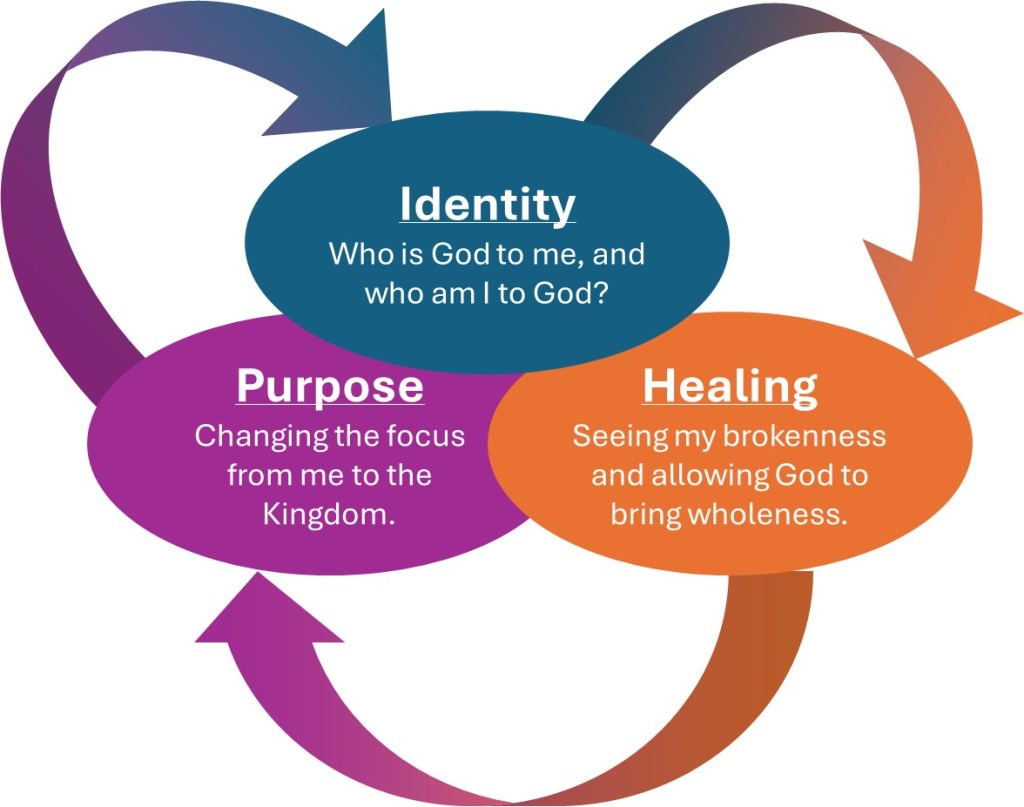






 From Pops' Workshop