Category: General

  • “Screwtape” on Freedom

    As I was preparing this message on Freedom and spiritual bondage, this letter came into my hands. It seems suspicously like what we read in C. S. Lewis’s Screwtape Letters, but I am certain this letter was never seen by Lewis.


    My dear Wormwood,

    Reading your last letter, it seems I must remind you of what you should have learned in your first year at the Tempter’s Training College! One of our chief aims is to keep our patients in prison. Not in physical prisons that constrains them bodily, but in spiritual prisons that bind their souls. Your patient can be imprisoned by anything that makes him desire his will over the Enemy’s will. There are any number of prisons he can be persuaded to enter.  Pride, drugs, prestige, relationships, physical health, career, pornography, wealth, alcohol, can all make excellent prisons; the possibilities are nearly endless. Most likely you will find your patient already in a prison. Most of them, well estranged from the Enemy, naturally find their way into spiritual bondage. Anything that serves to keep your patient’s attention away from the Enemy can become his prison.  What does he rely on?  What does he find himself drawn to? Those are your candidates for his prison.  Anything that pulls him into himself and away from the Enemy, that becomes his prison.

    Once he is in a prison you must keep him from suspecting that he is indeed in bondage. He must believe that he can walk out of prison anytime he wants to. As long as he thinks he is in charge, he remains safely in our tender care. Never let him feel the bars of his prison; never let him know that he has no freedom.

    For your position is still not secure: The Enemy will be trying to free your patient. Unlike our Father below, he foolishly desires to preserve the free will of his wretched creatures. He won’t compel his creature to come out to him, but he will contrive to let a little sliver of light into the dungeon, to make your patient aware of his bondage. That is the most dangerous time for you, when your patient begins to realize that he is in a prison and cannot get himself out.  Should this be the case, your strategy is simple:  as soon as he begins to sense the hopelessness of his situation, let him out!  Let him have his victory! It will be easy enough to ensnare him again, likely in the same cage he thinks escaped, especially if you encourage his sense of self-sufficiency in managing his “escape.” Does he fancy himself clever?  Help him believe that his cleverness got him out.  Does he think his will is especially strong?  Let him believe that it is by strength of his will that he escaped.  Perhaps the most amusing:  if he thinks himself righteous, help him believe that his self-righteousness was his salvation.

    The key thing is to ensure that your patient maintains the delusion that he is managing his own life, that he is his own man — in charge of himself.  If he should realize the hopelessness of his situation, he may throw himself at the feet of the Enemy.  Your goal must be to keep his focus on anything except the Enemy and his dreadful cross, a power we have not yet been able to overcome. If your patient ever avails himself of that power and claims the Enemy’s so-called “mercy and grace” our case may be badly damaged, if not utterly lost. I need not remind you the penalty you will pay should you fail in this most basic of temptations and your patient is lost to us.

    Your affectionate uncle, Screwtape.

  • What Does Your Heart Desire?

    What Does Your Heart Desire?

    The process of spiritual formation, the internal transformation of souls, is a life-long pursuit for Christians and can be a difficult and confusing journey.  As with any journey, we need to know two key things:  where we are and where we are going.  If we do not know where we are now, it may be impossible to find our way to our destination.  If we do not really know where we are going, then any progress we make will likely be haphazard and could just as easily move us farther away as move us closer to our end point.

    For our spiritual journey, knowing where we are now is largely a matter of knowing who we are and, to a lesser extent, knowing how we got to be where we are. I earlier wrote about knowing ourselves and the importance of being known.

    Knowing where we are going, is not really very hard, but it is something many of us either don’t think about or assume some generic, vanilla version of christian maturity.  But the reality is that each of us carries within us a God-given spiritual longing.

    I recently had occasion to contemplate my destination. The Lord pointed me to Psalm 1’s description of a Godly person, focusing me on verse 3:

    He is like a tree
    planted by streams of water
    that yields its fruit in its season,
    and its leaf does not wither.
    In all that he does, he prospers. Psalm 1:3 (ESV)

    As I thought and prayed about what this verse might mean to me, as a spiritual longing, here is what I came to perceive what I am being called to.

    I long to be a tree: Strong, alive, providing shelter and shade
    Planted: Immovable, unshakable, deeply rooted in the knowledge of God’s love for me
    By streams of water:  Drinking deeply of living water— love that flows from the heart of Jesus. Flowing — always new, continually refreshed and refreshing.
    Yielding fruit in its season: Not forcing fruit out of season, but content in times of fruitlessness. In season, obediently yielding Godly fruit to feed and nourish others.
    Whose leaf does not wither: with growth and life even when there is no fruit, unaffected by the hot and dry seasons.
    Prospering in all that I do:  Prospering not for personal enrichment or gain, but being aligned with the Father’s heart, prospering in kingdom purposes.

    That is my longing, my aspirational state. What is yours? I encourage you to take the time, perhaps with a Spiritual Director or other trusted spiritual friend, to prayerfully consider where you have been with God, where you are today, and what you are being called to.

    What is your heart longing for?

  • Climbing the Mountain of God

    Climbing the Mountain of God

    In the beginning the way is broad and easy.  The road is smooth and the ascent is barely noticeable. I walk happily and easily along the gentle slopes.  I have my pack well-stocked an and on my back. I also have my wooden two-wheeled cart, loaded with my most cherished possessions. Even loaded as heavily as my cart is, it is smooth and easy to push it along in front of me.

    Slowly, almost imperceptibly, the path narrows a becomes a bit less smooth.  The incline seems to increase with each step I take.  As I round a bend I can look back and see that I am indeed climbing more rapidly. The way ahead seems even steeper yet. I can still manage the journey, but it is no longer easy.  I must stop and rest more often.

    Soon my times of rest become more frequent and longer, comprising the majority of my time.  My arms and shoulders ache from the weight and strain of pushing my cart before me. The path is becoming less smooth and my card lurches from side to side and crashes down into ruts and over ever larger rocks in the path. Despairing at my lack of progress and worried that I may lose a wheel or snap the axle of my cart,  I decide to lighten my load.  I sift through mounded cart, discarding what I think I can do with out.  It saddens me to leave behind the things I worked so hard to provision myself with, but there is no other way.

    With my burden lessened, my trek is once again easy; my strength is once again sufficient.

    As I resume the assent, the way becomes every narrower. The once broad avenue is now a narrow foot path.  Shrubs and low tree branches grab at my cart, trying to stop my progress.  I push on through them but soon find that huge rocks on my left form a virtual wall.  On my right, a once gentle slope down has become an alarming precipice. The sides of my cart scrape and catch on the rock wall, threatening to push it off the edge to the right.   

    In a rare wide and level spot I stop to assess my situation.  My cart has taken a beating.  I am exhausted trying to keep it from going over the edge.  The way forward seems even more treacherous and narrow.  If I am to go forward  I must abandon my cart.  Yet I have worked so hard to gain my possessions and to bring them this far up the mountain. I sit in that spot for a long time.  My things are so dear to me!

    Eventually, I make up my mind.  I will give up my cart but contrive to keep as many of my things as I can.  Casting my cart aside, I sift through my belongings, judging what I hold most dear and what I’m willing to let go of. In the end, I repack my backpack, adding some of my most cherished things.  Still other things are added to the outside of the pack, lashed in place with make-do straps. 

    With my burden lessened, the way again is easy.  My strength is once again sufficient. The narrow places are no longer such a challenge.

    No sooner have I found a comfortable pace and start to be content with my progress then the terrain changes yet again, becoming more and more difficult. The path becomes steeper and the footing less sure. At times I am climbing as much as walking.  The weight of my pack, combined with some nearly vertical climbs threatens to pull me over backward. As before, I find my need for rest stops coming more and more frequently. 

    I know what I must do.  I pare my pack down, leaving behind everything I dare, leaving only the essentials — food, water and the few things I am sure that I will need for my journey. But soon even that is not enough.  The path is too narrow, too steep and too treacherous. Soon I am forced to abandon my pack entirely, trusting that somehow I will reach the summit before I succumb to hunger or thirst.

    Unburdened, the climb (for it is not now a hike) becomes easier.  Then, unexpectedly, the nearly vertical path slowly begins to level off.  As it levels, it broadens.  The boulders that hedged me in for so long become fewer and smaller.  The harrowing precipice also ends.  The change is subtle and revealed only over time.  Yet soon I find myself on a smooth broad road.

    Looking back, I spot my backpack, left far below. Even further back, so far back that it is hard to believe I can spot it, is my abandoned cart, a mere speck. Looking ahead, the path remains broad smooth, slowly climbing upward.  Not very far ahead I see cool streams of clear water and fruit trees in abundance. It is a natural garden.  For a moment I wish I had my cart, it would be perfect here.  Then I laugh at myself, realizing that I have neither need nor want for the things I once prized so highly but left behind along the way. 

    I know that I have not reached the summit, but here, in this garden, I know that I am close. Any sense of urgency I once had is gone. I am free to tarry or proceed. Each step forward now reveals new delights: an especially beautiful flower, an exquisite new fruit to enjoy, a warm and sunny spot to sit and hear the music of a stream flowing over cataracts.

    I do not know what is next.  I feel neither urgency to press on nor a desire to linger. In my freedom I continue on my way at a pace dictated by God, enjoying the beauty of his mountain. 

  • When the Fruit Fails

    When the Fruit Fails

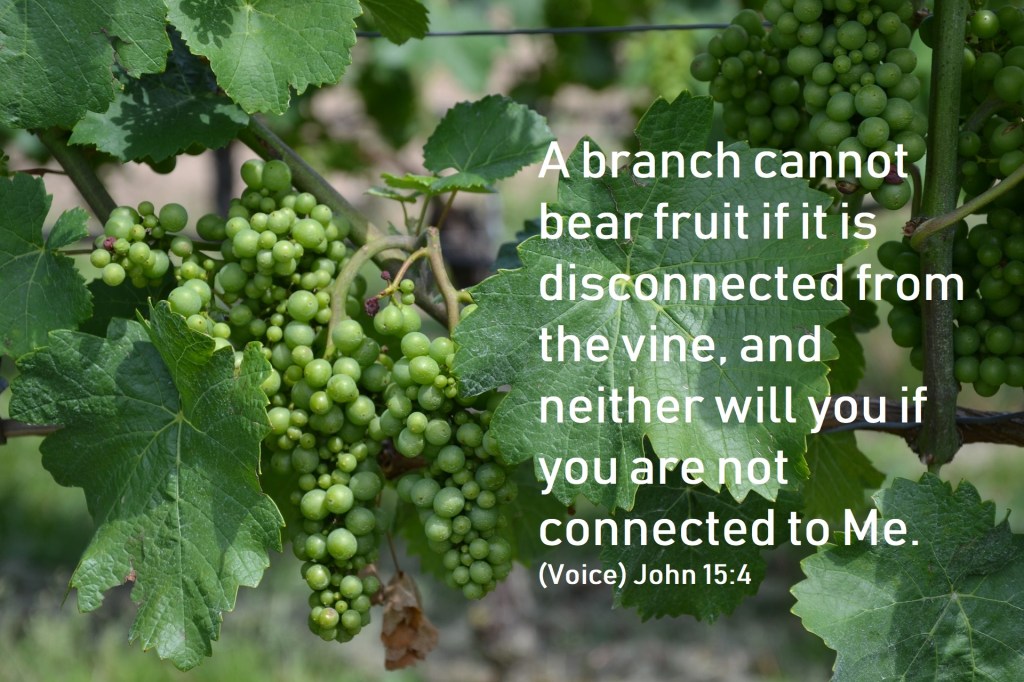
    Have you found that God seems to begin some good work in you only to have it seem to evaporate, to disappear, as if it had never been there at all? He may have begun some emotional healing, restoring some relationship, or bringing some fresh awareness or understanding in your life. Then, some time later you discover that what you thought was being born in you seems to have been illusory. To use the metaphor of grapes growing on a vine, we see the small, round new grapes appear on the vine, but then, as time goes on, instead of maturing to ripeness, the grapes have withered and died.

    All of us, at sometime or another, have found ourselves hurting, scared, and not knowing where to turn. Finally, we cry out to God. We find that God is good. We find that things start to change. Or perhaps our understanding and acceptance starts to shift, perhaps God speaks to us in our pain and starts the processes of healing and formation.

    As our pain starts to subside, we carry on with our lives and one day we find ourselves in distress again. We turn back to God, looking for that nascent fruit we had seen before, only to find it is nowhere to be seen. It has evaporated like the dew. What has happened?

    Jesus gives us an answer in John, chapter 15.

    “I am the true vine, and my Father is the vinedresser. Every branch in me that does not bear fruit he takes away, and every branch that does bear fruit he prunes, that it may bear more fruit. Already you are clean because of the word that I have spoken to you. Abide in me, and I in you. As the branch cannot bear fruit by itself, unless it abides in the vine, neither can you, unless you abide in me. I am the vine; you are the branches. Whoever abides in me and I in him, he it is that bears much fruit, for apart from me you can do nothing. If anyone does not abide in me he is thrown away like a branch and withers; and the branches are gathered, thrown into the fire, and burned. (ESV) John 15:1-6

    Too often, when we first see fruit start to appear, the baby grapes on the vine, we declare victory and move on. Without even thinking about it, with our pain assuaged, we take a step back and disconnect from God. Rather than abiding with God, we detach our branch from the vine. Little wonder the fruit withers and fails!

    When the fruit fails, rather than wondering what happened to it or if it was ever really there, we should make sure that we haven’t broken ourselves off the vine. God cannot mature the fruit (and us!) if we do not abide in him.

  • Belief is the Easy Part (Relatively)

    Belief is the Easy Part (Relatively)

    For many of us, coming to believe in Jesus as Messiah and the son of God was a hard, hard, thing to do.  I know it was for me.  Indeed, Scripture tells us that we can’t come to belief on our own, it is only through God’s grace.

    “For it was only through this wonderful grace that we believed in him.”
    Ephesians 2:8(a) (The Passion translation)

    And yet, it turns out that believe is relatively easy when compared to the day by day, hour by hour, minute by minute, second by second work of discipleship, that is, turning away from what we want and toward what God wants.

    Consider Mark’s account of Peter’s confession of Christ (Mark 8:27-38). Jesus ask his disciples who do people say that he is and then who do they say that he is. Upon Peter’s identification of Jesus as the Christ, Jesus tells his disciples what it means for him to be Messiah: betrayal, injustice, and death.  Peter is unwilling to accept this and rebukes Jesus, who cutting to the heart of the matter, rebukes Peter:

    But Jesus turned around, and glancing at all of the other disciples, he rebuked Peter, saying, “Get out of my sight, Satan! For your heart is not set on God’s plan but man’s!” Mark 8:33 (The Passion Translation)

    Peter believes, he had just confessed Jesus as Messiah, but is heart is not set on God’s plan.  Jesus goes on to explain that we really have only two ways open to us. We can give up our lives for true life or continue holding on to our own lives, which leads us to death. We are not given the option of a third way.

    Surrendering to Jesus’ ways, taking up his cross,  and disowning our own lives is the necessary, continual work of discipleship.  It can be hard — very hard. All of us do imperfectly.  Most of us do it very imperfectly.  The good news is that we don’t have to reshape our own hearts.  God does the hard work.  We just have to remember to let go and get out of the way so that he can have his way with us. He will, if we let him, keep our hearts set on his plan and not mans.

    Are you on the road of discipleship?


    This post is derived from a sermon I preached recently.  You can listen to that message, if you want more on the hard work of discipleship.

  • Why God Doesn’t Have My Artwork on His Refrigerator

    Why God Doesn’t Have My Artwork on His Refrigerator

    At sometime or another, nearly every parent’s refrigerator starts to resemble an art gallery.  We take the wonderful, if not fully recognizable, artistic renderings our children produce and put them on display on the ‘fridge door.  But I think my Father in heaven doesn’t have much of my artwork on his ‘fridge.  Why not?  Because long ago I stopped producing any artwork for him to display.

    I am blessed to have a delightful two-year-old granddaughter, Anna.  She recently got her hands on a harmonica and delights in “playing” her harmonica and dancing — in her mind dancing is integral to playing the harmonica!  Seeing her play and dance made me think.

    I have several harmonicas.  They sit in a box, unused. I used to play them. I tried to teach myself — to become at least proficient, but in the end I convinced myself that I’d never be very good and stopped trying.  I put my harmonicas away.  I’ve done the same thing with other musical instruments and with painting and even with my writing.  In each case, I convince myself that I am “not that good” or not “good enough.”

    But a two-year-old knows something I have forgotten:  the point of playing the harmonica is to enjoy being creative; it is not to impress others with our skill.  Anna plays and dances with abandon, deep in the joy of creative expression.

    Our God is a creative God. Since we are made in his image, we too are to be creative.  It is part of our design. When we stifle our creative urges we keep a part of ourselves, the creative part made to create, play, sing and dance, from God.  We keep ourselves from being all we are intended to be.

    If you feel like painting, paint.  If you feel like writing poetry, write poems.  If you’d like to dance, dance. It doesn’t matter if anyone else ever sees or hears your creative expression.  And if you feel like playing the harmonica and dancing, follow Anna’s lead and do it with gusto and joy!

    Don’t be surprised if God starts to commune with you through your creative impulses. We are told be childlike in our relationship with the Lord — to come to Jesus as little children. Part of being childlike means to stop censoring our creativity; stop being self-conscious and self-critical.  Take joy in creative expression simply because you are enjoying this God-given part of your nature.  Create some masterpieces for your Father to enjoy on his refrigerator.

  • The Love of a Father

    The Love of a Father

    On Father’s Day the Arizona Republic ran a front page story by Karina Bland headlined A boy’s new life. It is a warm and wonderful story about a man, Nick Dugas, who reached out to help an abused, runaway 12-year-old boy nicknamed “Bug”. Nick eventually adopted Bug. It is a story of selfless and unconditional love.

    I have never met Nick and no nothing about him that you won’t know after you read the Republic article. No doubt he is as flawed as any of us, but the story of Nick and Bug can be a powerful reminder of how our Father reaches out to us, saves us, and makes us his own.

    Nick discovered Bug lying down in the shade of a building in Phoenix one morning. He offered the boy a meal but was rebuffed. Nonetheless, noticing that the boy had a cell phone, he wrote down his number and said that if the boy decided he wanted help, just give him a call. Nick was barely back to his car before his phone rang.

    Nick gave Bug food and clothing and a safe place to sleep. At first Bug didn’t stay; he would come and go from Nick’s house. As trust grew, Bug eventually decided to stay. Nick provided Bug a room of his own and made sure he attended school. Eventually, after learning that Bug’s father had no interest in him, Nick took the necessary steps to become Bug’s foster parent and eventually his adoptive father. At his adoption Nick wisely told Bug that his anger and his hurts would take time to heal but that he was now loved unconditionally and was safe.

    This wonderful story is a good reminder of how God, our Father, cares for us. He finds us, often hurt and alone, and offers a way out when we have absolutely nothing to give him in return. He doesn’t suggest that if we clean ourselves up and get our lives back on track, only then will he accept us. He offers to take us in the way we are, clean us up, feed us, keep us safe, and love us. We are free accept the offer or, as Bug did at first, decide it is not for us. Nonetheless, in God’s Word and in the presence of believers around us, we “have his number.” If we call out to him he is always their for us, as Nick was when Bug called him.

    We are often distrustful of God’s goodness and fidelity, thinking surely there must be a catch! Even when we do accept help we often withdraw, preferring to live life on our own terms (seeming to forget that we were not doing it very well). But each time we return our Father is there, waiting for us, watching for us, welcoming us back into his home. He patiently waits for us learn that he really does love us and wants nothing more than the love of a son or daughter in return. As we grow closer to our Father’s heart we can learn to trust; We can let him begin the healing of our hearts and souls.

    Unlike Nick and Bug, we don’t have to navigate a bureaucracy before we are adopted. When we have faith in Jesus we are adopted as his brothers and sisters. We have access to the lives we were always intended to have: lives where we experience the love of God and enter into the mutual love that the Father, Son, and Holy Spirit have always enjoyed. Our hurts may not heal overnight, but we can know that we are safe in the unconditional love God.

  • It Is Time to Choose a Side!

    We can chose Jesus’ side, which allows no divisions. Everyone is part of us. Or we can chose the world’s side, a life of constantly deciding who is in and who is out, whom we should love and whom we can marginalize, and struggling to maintain our place on the right side of countless lines we have drawn and wondering whom we have left to love and who can love us.

    Here is a message I preached recently:  http://subspla.sh/cr6wfxs

  • The Root of our Problem

    The Root of our Problem

    Pride is Satan’s signature sin. Pride caused Satan’s fall and pride caused our fall. As the great Reformer theologian John Calvin observed, “Hence flowed ambition and pride, so that the woman first, and then her husband, desired to exalt themselves against God.”

    Pride takes many forms. There’s vanity, the love of self.  There’s a sense of entitlement, impatience, arrogance, hubris, desiring relevance or appreciation, incessant dissatisfaction, complaining, demanding.  Pride is a stern master.

    But God has given us an escape from pride. Listen to learn how you can be freed from pride and free to become your best self.

    That is how my Pastor, Graeme Sellers of Wonderful Mercy Church,  summarized the message I preached on March 11th.  I couldn’t ask for a better summary.

    You can listen to that message, “The Root of Our Problem,”  here.

  • Spinning Our Straw Into Gold

    Spinning Our Straw Into Gold

    Recently I was reminded of how the Lord can take the straw of our very imperfect efforts and spin it into kingdom gold. A child we had sponsored years ago reached out and contacted me through social media. My family has been sponsoring children through Compassion for many years. Compassion is a great organization and does fantastic work, addressing spiritual, emotional, and relational needs of children, in addition to their material needs.

    Although we have always been faithful with our financial support of the children we sponsor, we have not always been faithful in prayer and supporting the children relationally by corresponding with.  When you sponsor a child through Compassion you are the one and only sponsor that child has.  Since Compassion works through local churches the children had other Christian adults sewing into their lives but the children especially value hearing from their sponsors.

    Ten years ago we began sponsoring a college student in Thailand through the Leadership Development Program.1 Our LDP student in Thailand was just beginning her time at the university and we were able to support her for three years, until she graduated. As with the school-age children we sponsored, we weren’t the best sponsors, but God took our imperfect works of straw and spun them into Kingdom gold.  He combined our efforts with whoever her through her previous sponsors, her local church, the Compassion workers in Thailand, and His own power to produce a very good end indeed.

    Our former LDP student recently contacted me via social media: she is now working in Christian ministry in Thailand and as I write this she has travelled with Compassion from Thailand to Australia where she is visiting churches to share her testimony about how God has worked in her life.   I am very proud of the small part we were able to play.

    Her story reminds me of how God takes our most ineffective actions, whether we are seeking to do kingdom work or just to know him better and hear his voice, and spins our straw into gold.  We don’t have to wait until we are good enough or have it all sorted out.  We just have to start.  He is there to meet us WAY more than half way, if we just take even the first halting steps.


    1. The Leadership Development Program, which allowed us to sponsor a child in college no longer exists, but Compassion does have Youth Development Fund.

    Featured photo: Narsil/shutterstock.com